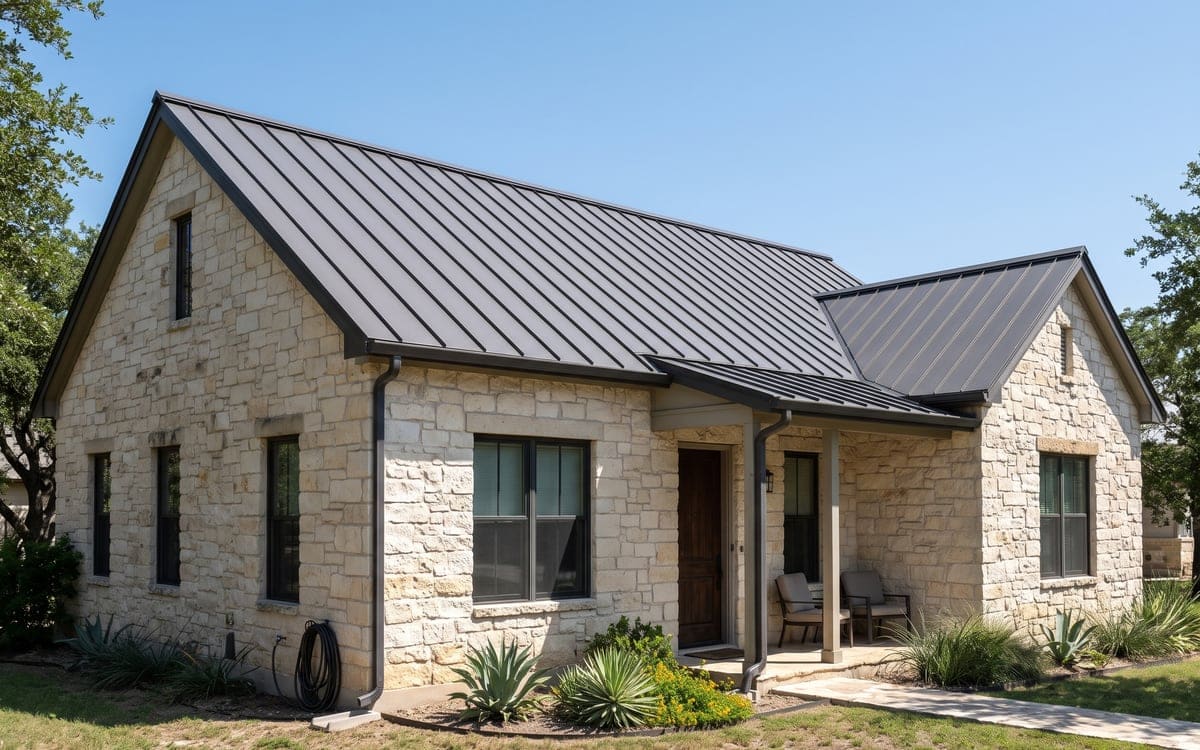
Panels stand up at the seam
A standing seam panel is a vertical panel whose edge is bent up and folded over the neighboring panel to form a tight joint, which raises the seam above the roof surface,1 per the MCA's installer manual.
Panels sort into two families on the deck. One group is structural panels, which span open framing and normally need no solid deck;1 the other is non-structural architectural panels, which need a solid deck.
The seams stand up and the clips stay hidden
In a standing seam roof, concealed clips sit along the panel edges and do not pierce the panel, so when installed properly the main roof surface shows no fasteners except at the eave.1 Most clips are designed and supplied by the roof system maker for a single panel type, and clips and cleats are concealed and normally not visible once installed.1
Through-fastened panels are a different family. The MCA describes them as panels held down by threaded fasteners with washers that go through the panel, with the fasteners staying visible on the finished roof,1 and notes they need extra care installing the fasteners so they seal properly, and may have length limits because of thermal movement.1
The MCA says a roofing fastener must be straight and tight; under-tightened ones leak and over-tightened ones deform the panel, and a stripped fastener is replaced rather than covered with surface sealant.1
Some standing seam systems are seamed on site. Mechanically seamed panels are partly folded at the factory and finished on site, usually with an electric seaming machine that is normally specific to each panel system.1
Clips let the metal move with Austin's heat
Austin's heat is the invisible stress on a metal roof. Camp Mabry's normal summer high is 95.9 degrees and its normal summer low is 74.3 degrees.2 A metal panel in that heat may change size significantly on a regular basis, which is normal and has to be handled in the design and installation,1 per the MCA installer manual, and the longer the panel, the more it expands and contracts, different metals on one roof move by different amounts, and a panel should be pinned in only one location.1
What matters for thermal movement is the panel surface temperature, not the air temperature, and lighter colors and high-gloss finishes run cooler than dark, low-gloss ones.1
The clip is the piece that lets the metal move without pulling the roof apart. On a short run, a one-piece clip rolls and flexes; on a long run, two- or three-piece clips let the panel slide,3 per NRCA. Each concealed-clip panel is pinned at a single point of fixity, the ridge, the eave or the midpoint, so it can move elsewhere, and accessories or trim can accidentally pin a panel a second time.1 NRCA's take on getting that wrong is that metal roof systems can be the least forgiving of all roof systems when provisions for expansion and contraction are neglected, and those factors are often overlooked.3
Aluminum moves more than steel. NRCA gives aluminum an expansion coefficient of 0.0000129 inch per inch per degree Fahrenheit, about double steel's 0.0000067, and works an example in which a 40 foot aluminum panel changes length by about 0.62 inch over a 100 degree swing.3 On a long aluminum run that movement is what every clip and seam has to carry.
The deck and underlayment under the panels
An architectural standing seam roof needs a solid deck underneath. ARMA writes about shingle roofs that underlayment gives secondary protection from wind-driven rain, helps keep the deck dry until shingles go on, and is a required component of a fire-classified roof assembly.4 For a metal roof, the MCA manual says the underlayment gives temporary weather protection until the panels go on, separates the panels from the deck and acts as a secondary weatherproofing layer if moisture gets past the panels.1
| Part | What it does | What to know |
|---|---|---|
| Panel | Vertical panel whose folded edge forms the seam (MCA) | Length drives thermal movement; longer panel, more movement |
| Standing seam | Raises the joint above the roof surface | Some standing seam systems are seamed on site with a system-specific machine |
| Clip | Fastens the panel to the deck under the seam | One-piece clips roll and flex; two- or three-piece clips let the panel slide |
| Point of fixity | Pins the panel in one place | Ridge, eave or midpoint; accessories can accidentally pin a second time |
| Underlayment | Gives temporary protection until panels go on; separates panels from deck (MCA) | ARMA on shingle roofs: a required part of a fire-classified assembly |
Wildfire areas and historic houses in Austin
In an Austin Wildland-Urban Interface zone, the covering has to meet the City's rules. Austin Fire's WUI code requires a Class A rated roof covering in all three WUI zones.5 The Metal Roofing Alliance says most metal roofing carries a Class A fire-resistant rating.6 The City's interactive map is the starting point; Austin Fire confirms Zones A and B on site by measuring.
Historic houses are a separate story. For an Austin landmark, standing seam metal roofs are generally not acceptable for historic landmarks unless the owner can document that the building historically had one,7 the City's Historic Design Standards say. The Historic Preservation Office decides for a specific property. Metal roof or shingles looks at the trade-off across the whole house.
Roof repair in Austin and metal roofing in Austin are the pages that pick up the repair side; roof installation in Austin covers a new standing seam roof from the deck up, and roof replacement in Austin covers tearing an older covering off before the new metal goes on.