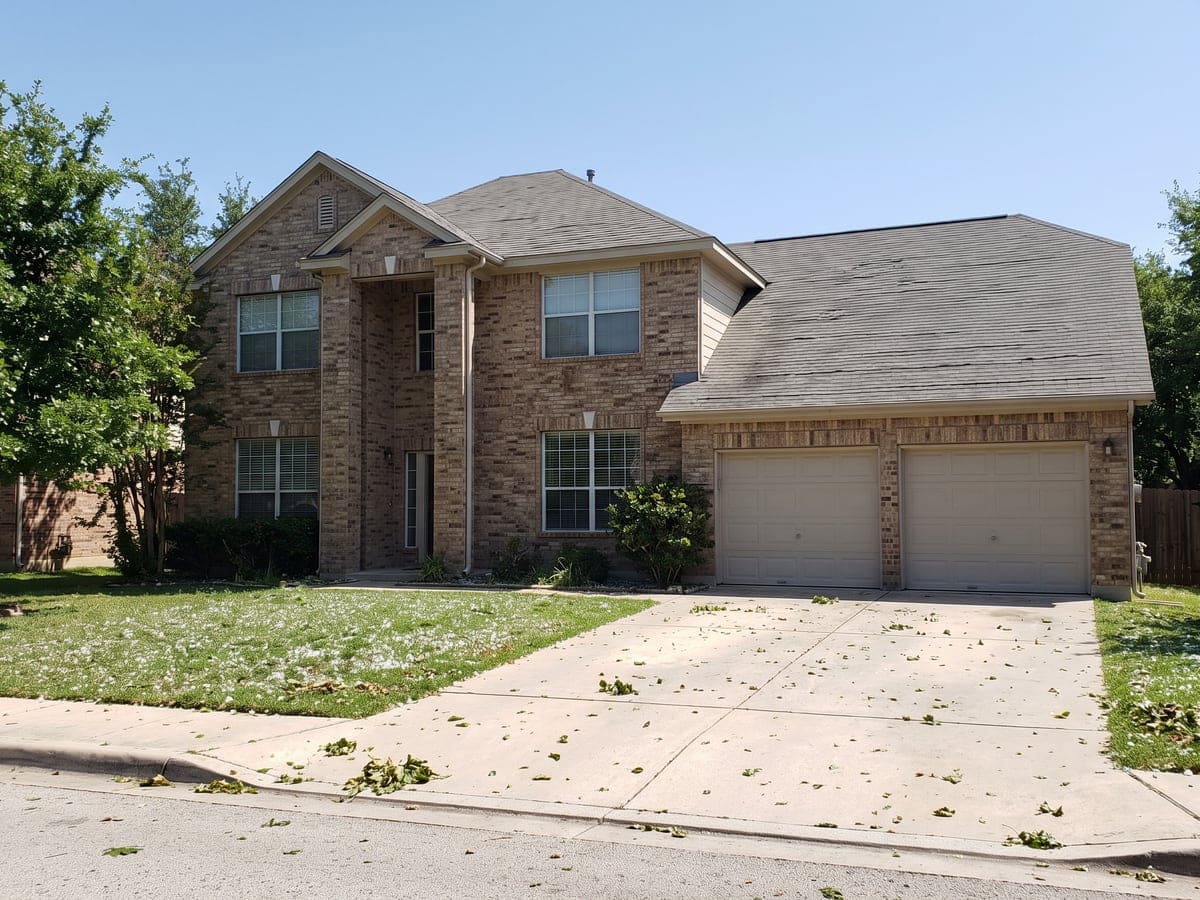
What our roofer checks after hail or wind
1. The soft metal first
Vent caps, gutters and downspouts take dents in hail. NOAA's narrative of the March 25, 2009 Austin hail storm says large hail dented cars and gutters.1 The gutter run gets a walk, every vent cap a look, and the metal apron at skylights and dormers the same.
2. Shingles
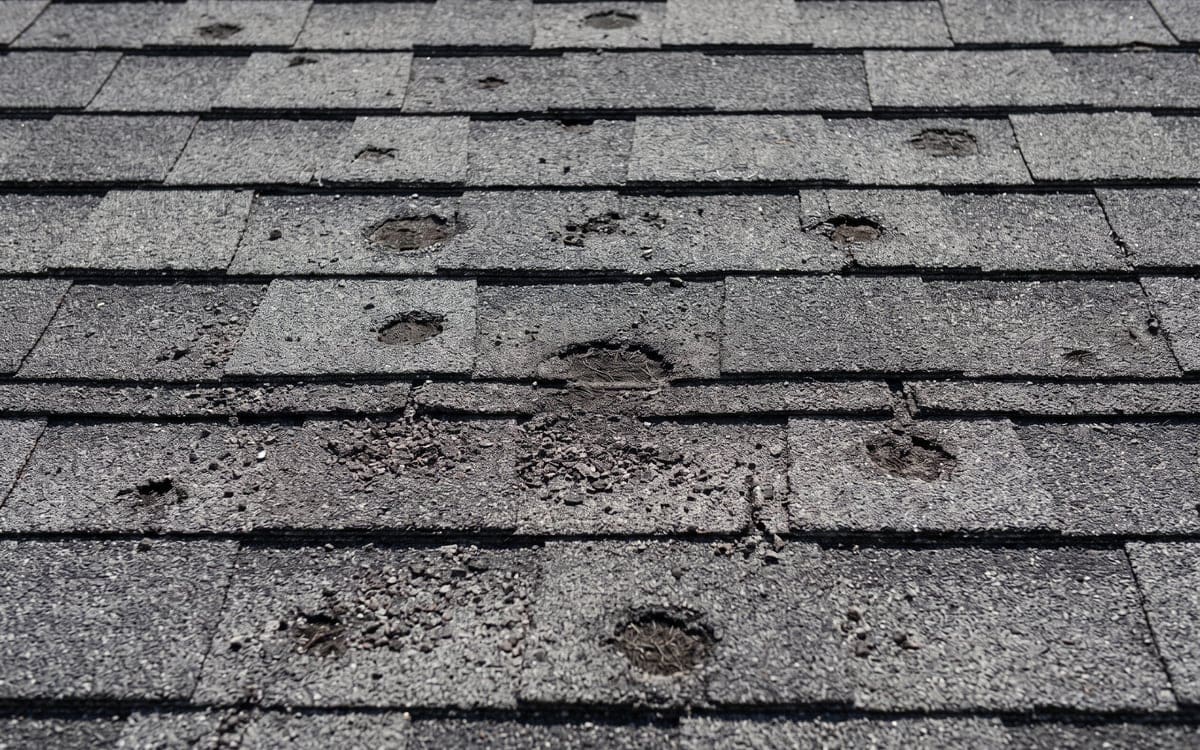
Then the shingles. IBHS judges impact-resistant shingles on dents, tears and granule loss,2 the damage seen in real hailstorms, and dents and tears can let water through a shingle while lost granules expose the asphalt to ultraviolet light.3
3. Wind on the tabs
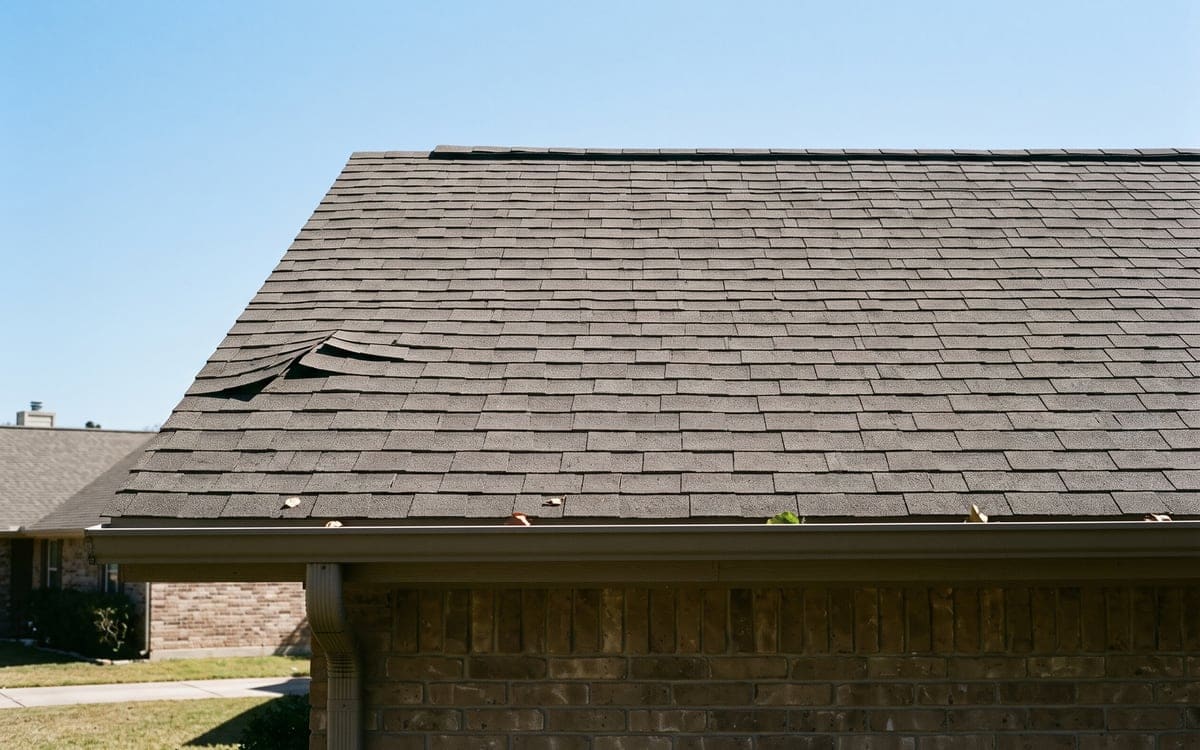
Wind looks different from hail. Most wind damage begins at the edges of a roof system,4 NRCA says: once material loosens, suction raises it and the exposed underside gives wind more to grab. Creased or missing tabs, shingles that broke their seal strip, and lifted hip and ridge caps all go on the list.
4. Ridge, hips and edges
The ridge vent housing, the ridge cap shingles and the rake edge where the drip edge meets the first shingle each get a look. Windblown debris such as glass and tree branches4 can severely damage a roof, so a storm check also looks at what blew onto it.
5. Metal and tile roofs
On a metal roof, hail dents sit on the panel. Many metal roofing products carry the highest impact resistance given by UL5 and hail typically does not penetrate a metal roof,5 the Metal Roofing Alliance says. For a worn or dented one, a metal roof has its own page. A tile roof gets checked tile by tile. A limb still resting on the roof goes to a tree trade first, before the roof conversation starts.
6. Inside: the attic and the ceilings below
Then the look moves inside. The attic from the hatch shows daylight through a punctured deck, damp wood or stained insulation. The ceilings below the worst slope get a look for a fresh ring or damp spot. For a known drip, our leak repair page is the next step; for water coming in now, our emergency repair page covers the first visit.
| Symptom | Likely cause | What it usually needs |
|---|---|---|
| Dents, tears or lost granules on shingles | Hail | A close look, then repair or a new roof |
| Dents in vent caps and gutters | Hail | A look at the shingles around them |
| Granules washed onto the driveway | Hail or wear | A close look at the shingles |
| Creased or missing tabs | Wind | Replacing those shingles |
| Slipped tiles or cracked tiles seen from the yard | A limb that has since been removed | Replacing the tiles |
| A stain after the storm | Water through a damaged spot | Leak tracing and a repair |
What hail does to a roof
Since 2019 IBHS has rated impact-resistant shingles with laboratory-made hailstones2 and judges them on the damage seen in real hailstorms: dents, tears and granule loss. Hail can strike anywhere strong thunderstorms form,6 and asphalt shingles are about 80 percent of installed residential roofs and are frequently damaged in hail and high-wind events.7
Impact-rated shingles, as labels
Impact ratings are a label on the product. NRCA says UL 2218 rates shingles on resistance to steel-ball impacts8 with Classes I through IV standing for impact energies of 3.53, 7.35, 13.56 and 23.71 foot-pounds. ARMA says impact resistance is not required by the building codes.9 IBHS writers say neither UL 2218 nor FM 4473 accurately reproduces the damage3 found on real roofs after real hail, and that not all shingles labeled impact resistant perform equally.3 A Class 4 label says the shingle met the test, not that it gets through any hailstorm untouched.
After a storm, from the ground and inside
The storm just passed and the temptation is to go out and look.
Nobody goes out during or right after hail, a thunderstorm or an ice storm. Checking storm damage means climbing onto a potentially unsound structure4 and should not be attempted alone, NRCA says, and not in the dark either.4 OSHA writes that workers do not get on a damaged roof until its strength has been determined.10 Stay clear of fallen power lines, including ones hanging overhead,11 the CDC says, and the Red Cross adds that downed power lines can electrocute.12
From the yard, look at the ridge line, the gutters and the vents. Inside, look at the ceilings and the attic hatch. Minimizing water entry13 with buckets comes first on ARMA's list. A tarp is only ever a stopgap a roofer sets; roof openings should be temporarily covered with tarpaulins,4 and except in extreme situations, roof system repairs should not be attempted.
When this fits, and when another visit fits better
When a storm visit fits
- Hail just fell, large enough to dent soft metal
- A windstorm lifted or tore shingles you can see from the yard
- A limb has already been cleared off and the roof shows a cracked panel or tile
- Dents on gutters or vents after a storm, with the shingle condition unknown
When another visit fits better
If water is coming in now, our emergency repair page is the first visit. For a drip with no storm behind it, our leak repair page is more direct. For wear across all slopes with hail on top, the conversation moves to a new roof. For a plain look-over on an older roof, a roof inspection is the fit.
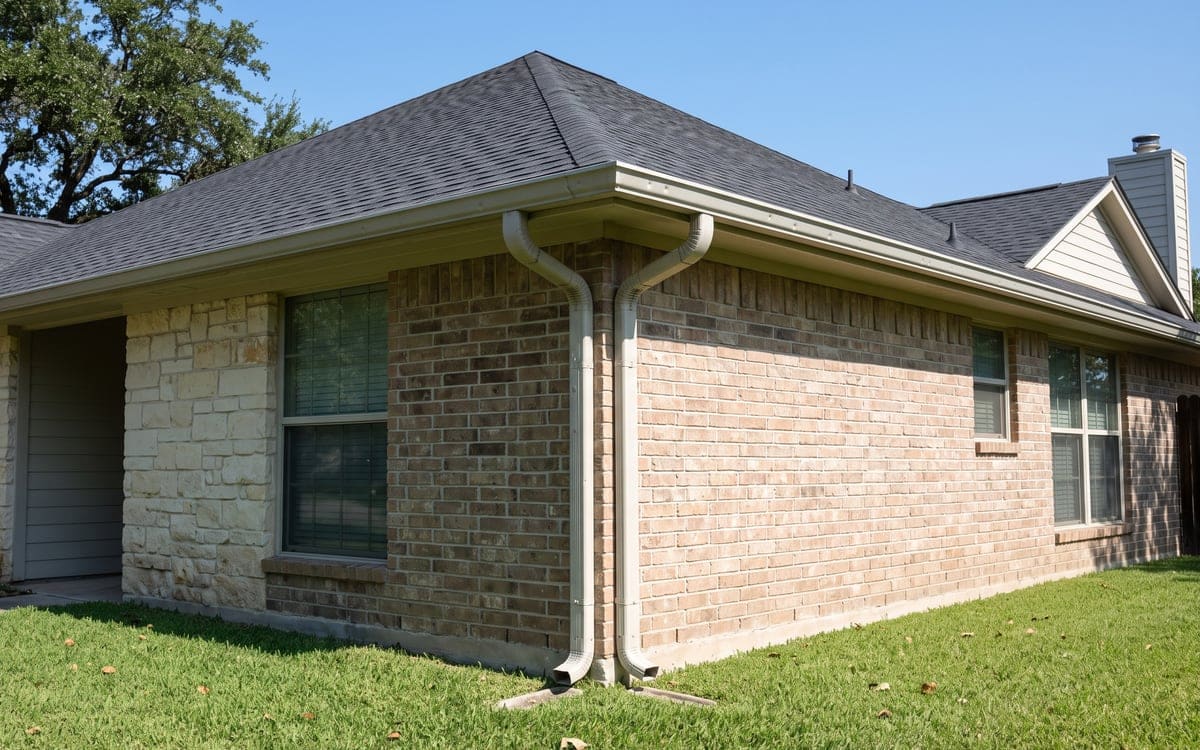
On a storm-damage visit, our roofer looks at the whole roof from the ground and from the eaves, then goes inside to the attic hatch and the ceilings below the worst slope.
Hail and wind in Austin
Austin's severe weather season runs mainly from March through May,14 the Weather Service writes, with most of it as large hail and strong winds. NOAA's Storm Events Database holds 274 Travis County hail reports of 1 inch or larger from 1996 to mid-2026,1 216 of them in March, April or May, May the busiest at 86,1 on 77 separate dates1 and in 28 of the 31 years from 1996 to 2026.1
Some storms stand out. NOAA lists 3-inch hail on Burnet Lane in Austin's Brentwood area and tennis ball size hail in several parts of Austin on September 24, 2023,1 and tennis ball size hail near MoPac and Far West Boulevard in northwest Austin on April 9, 2024.1 The largest hail in the Travis County rows is 4.00 inches, reported at Mueller Airport on May 14, 2008.1
Travis County has 187 thunderstorm wind report rows with a speed from 1996 to mid-2026;1 65 are 58 mph or faster, 11 are 70 mph or faster, and none reach 80 mph. Tornadoes in the city are mostly weak, EF0 to EF1;14 on May 23, 2015 an EF1 tornado touched down near Braker Lane,15 peeling back the sheet metal roof of a business and damaging shingles nearby.