Where the 25 percent idea comes from
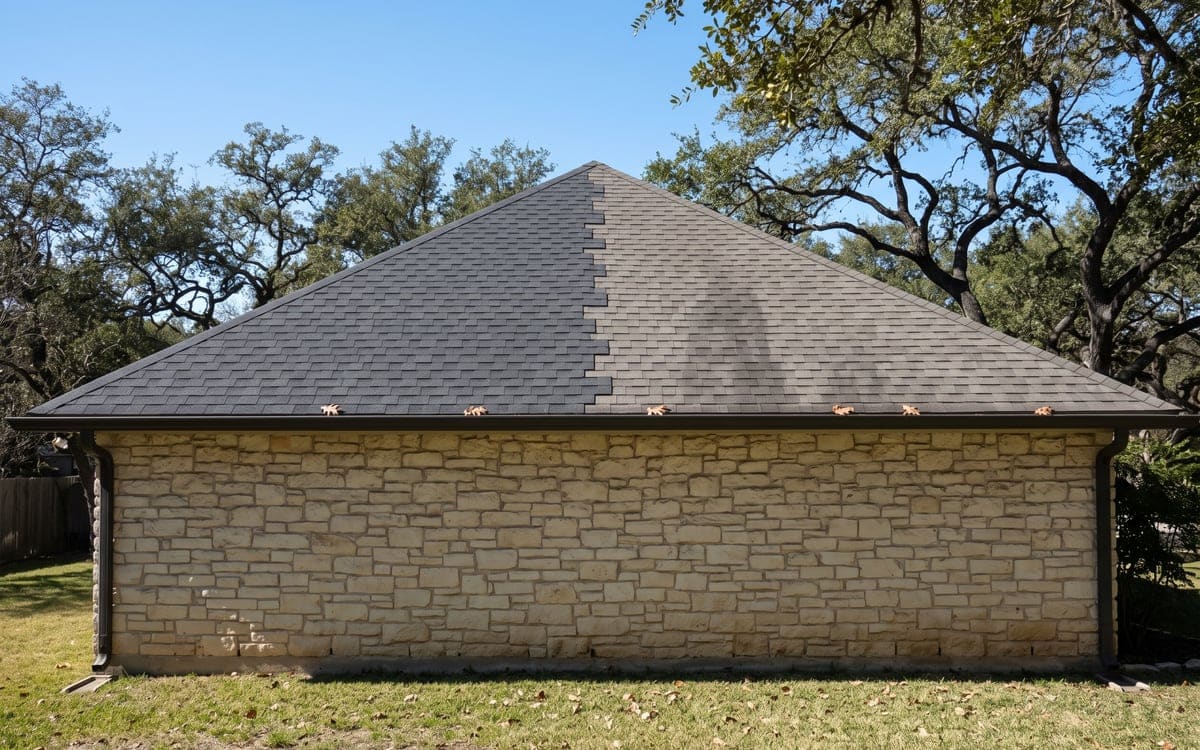
The 25 percent rule is a scope question: how much of a roof can be fixed before a repair turns into a whole new roof. The 25 percent figure people quote comes from Florida's building code; the 2021 model code's reroofing section names no percentage; and Austin's own line is the 50 percent wildfire-area rule.
The rule people quote is written into Florida's code
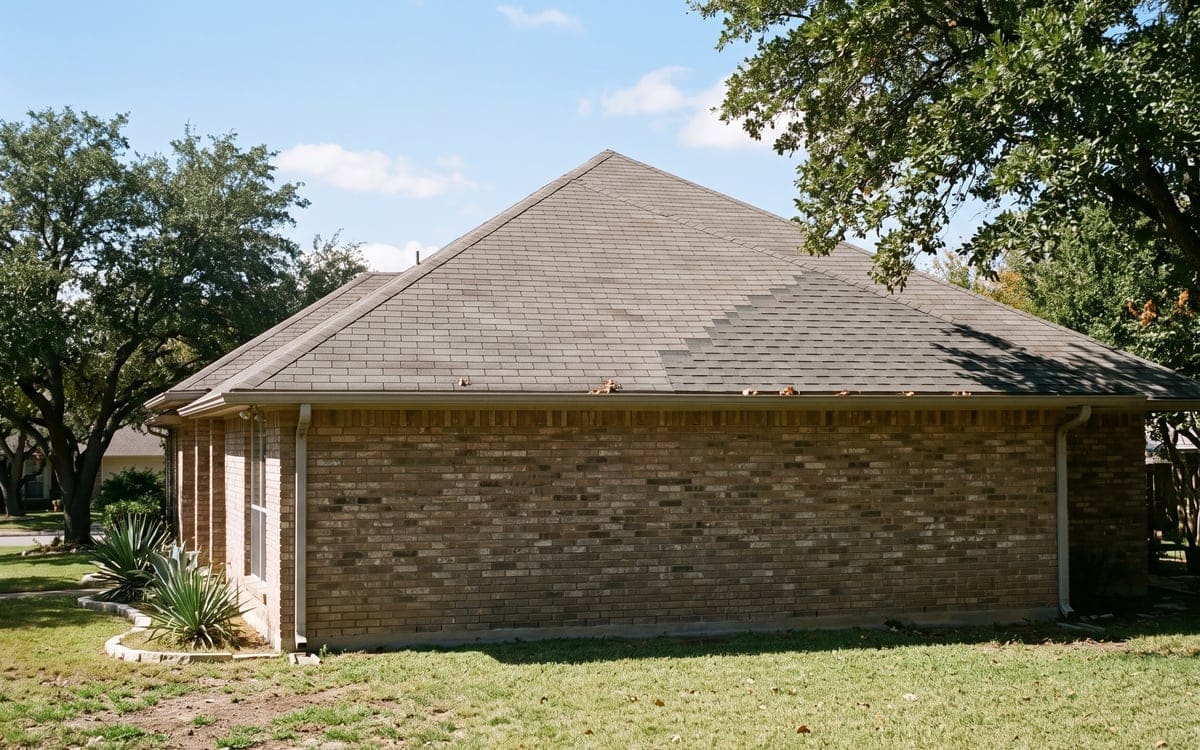
The source of the number is the Florida Building Code. The 2023 Florida Building Code, Existing Building, section 706.1.1, says not more than 25 percent of the total roof area or roof section of an existing building shall be repaired, replaced or recovered in any 12-month period unless the roof covering on the entire existing roof system or roof section is replaced or recovered to conform to the requirements of this code.1 The same sentence sits in the 2023 Florida Building Code, Residential, at section R908.1.1,2 and the 2026 Florida Building Code, Residential, Ninth Edition, carries it forward at R908.1.1.3
Three lines people mix up
Florida's rule, the 2021 model code and Austin's wildfire-area rule, as each is written.
Florida's code
- Not more than 25 percent of a roof repaired in a 12-month period
- Past that, the whole roof or section is redone
The 2021 model code
- No percentage in its reroofing section
- A recover turns on the old roof's condition and layers
Austin's wildfire areas
- 50 percent or more of the covering replaced
- Then all of it is replaced to new-construction rules
Sources: 2023 Florida Building Code, Existing Building, Eighth Edition, 706.1.1 (ICC Digital Codes); International Code Council (ICC), 2021 International Residential Code, R908.3.1.1 Roof recover not allowed (ICC Digital Codes); City of Austin Ordinance No. 20250410-041 (2024 International Wildland-Urban Interface Code and local amendments, City Code Chapter 25-12, Article 8).
The Florida section carries an exception: when a roof was built to the 2007 Florida code or a later edition, only the repaired, replaced or recovered portion must meet the current code.1 None of this applies in Austin.
The 2021 model code's reroofing section names no percentage
The 2021 International Residential Code is the national model text; Austin adopted the 2024 editions with local amendments, effective July 10, 2025.4 The 2021 IRC's reroofing section, R908, says the materials and methods used to recover or replace an existing roof covering must comply with the roof assemblies chapter.5 Roof replacement is defined as removing the existing layers of roof covering down to the roof deck.6 A roof recover is not permitted where the existing roof or covering is water soaked or has deteriorated to the point that it is not adequate as a base, where the existing covering is slate, clay, cement or asbestos-cement tile, or where the existing roof already has two or more applications of any type of roof covering.7
Each test turns on condition, covering type and the number of applications. The reroofing section holds no percentage.7 A 25-percent sentence does appear in the 2021 International Existing Building Code, on parapet bracing. The rule is stated in both Section 503.68 and Section 706.3.1:9 where a permit is issued for reroofing more than 25 percent of the roof area of a building in Seismic Design Category D, E or F that has unreinforced masonry parapets, the work includes parapet bracing unless an evaluation shows compliance. It is a seismic-category rule, not a repair-versus-replacement threshold.
Austin's line is 50 percent, and it belongs to the wildfire areas
Austin's own line sits in the City's permit code and in Austin Fire's wildfire-area code. The permit side first: Development Services says a building permit is not required when asphalt shingles replace existing asphalt shingles, unless the property is located in the Wildland-Urban Interface area and 50 percent or more of the roofing is being replaced,10 with the same exemption and WUI condition for any roof covering that does not adversely affect the roof structure.10
Then the wildfire-area side. The City's local amendment to the 2024 Wildland-Urban Interface Code says that for existing structures, replacing 50 percent or more of a roof covering requires replacing the whole roof covering, to the standard for new construction,11 and Austin Fire lists the same rule for all three zones: replacement of 50 percent or more requires full replacement.12
Austin was the first major city in Texas to adopt the International Wildland-Urban Interface Code,12 Austin Fire says; the 2020 adoption was revised in 2024. More than half of Austin falls into one of three WUI zones.12 The City's interactive WUI map is the starting point, and Austin Fire says Zones A and B are confirmed on site by measuring to the nearest wildland.12
Past the 50 percent line, Austin's WUI code pulls the covering onto the new-construction standard in Section 504.2. That means a Class A rated roof covering12 and, under 504.2.1 inside it, metal flashing or a woven (closed) valley with the flashing visible for inspection.12 Austin Fire's other zone rules sit in separate sections: noncombustible gutters with leaf guards,12 and ember mesh of 1/8 inch or less on attic vents, with window screen not acceptable because it melts.12 Austin Fire adds that existing buildings in Austin's WUI do not have to be updated to the current code; the 2024 version applies to new construction or development.12
The permit for a roof job past the exemptions is a Residential Express (Minor Repairs) permit, used for decking replacement of more than 128 square feet, or when over 50 percent of the roofing is replaced on a property in the WUI area.13 Roof replacement in Austin runs through what the whole-roof scope looks like, and metal roofing in Austin covers one of the Class A options.
What still applies without a permit
Permit-exempt work still has to follow the codes. Work exempt from a permit must still comply with applicable Building Codes, City Codes and all other applicable ordinances,10 Development Services says, and Austin Fire adds the same about the WUI code: even if a project does not need a permit, the work must still follow the WUI code.12
Development Services and the City's WUI map answer for an address. For an exempt covering job, the shingle maker's instructions still apply. In a WUI zone, Austin Fire's reminder stands: even when no permit is needed, the work still follows the WUI code.
| Rule | Where it applies | What it says |
|---|---|---|
| 25 percent rule | Florida | A roof may not have more than 25 percent repaired, replaced or recovered in any 12 months before the whole covering is brought to code; a 2007 or later roof falls under an exception |
| 2021 IRC R908 | National model code | No percentage of the roof forces replacement; conditions turn on the covering's condition, type and number of layers |
| 2021 IEBC 503.6 and 706.3.1 | High seismic categories only | A permit to reroof more than 25 percent requires parapet bracing on buildings with unreinforced masonry parapets |
| City of Austin permit exemption | Austin | Asphalt shingles that replace existing asphalt shingles, and any roof covering that does not adversely affect the roof structure, are permit-exempt; both carry the WUI 50 percent condition |
| Austin WUI 50 percent rule | Austin WUI zones A, B and C | Replacing 50 percent or more of the covering means replacing all of it to the new-construction standard |
What decides repair or replacement on your roof
The percentage of a roof involved is one input among several. ARMA says the existing shingles will likely need to be removed when there are two layers, when the structure sags across the ridge or truss lines, when the deck has rotted or warped wood, or when the old shingles are too uneven for the new roof to lie flat.14 Old shingles that are curled or badly weathered must be removed,15 ARMA says.
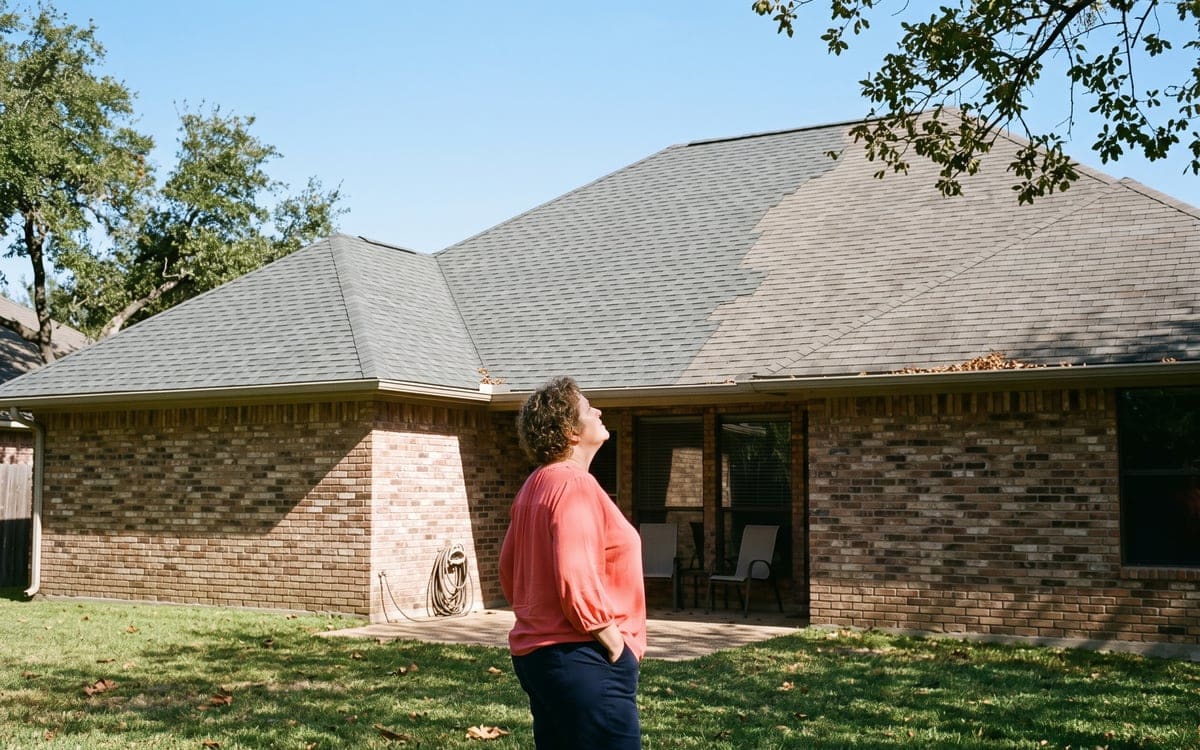
The 2021 IEBC's definition of a roof repair is reconstruction or renewal of any part of an existing roof for the purpose of correcting damage or restoring the predamage condition.16 A roofer looks at the spread of damage, the number of layers, the deck and the wear across the covering before deciding. A roof inspection in Austin is one way to sort the scope, a smaller roof repair in Austin stays open as long as the covering can hold up, and roof storm damage work is the sibling page if a storm is the reason.