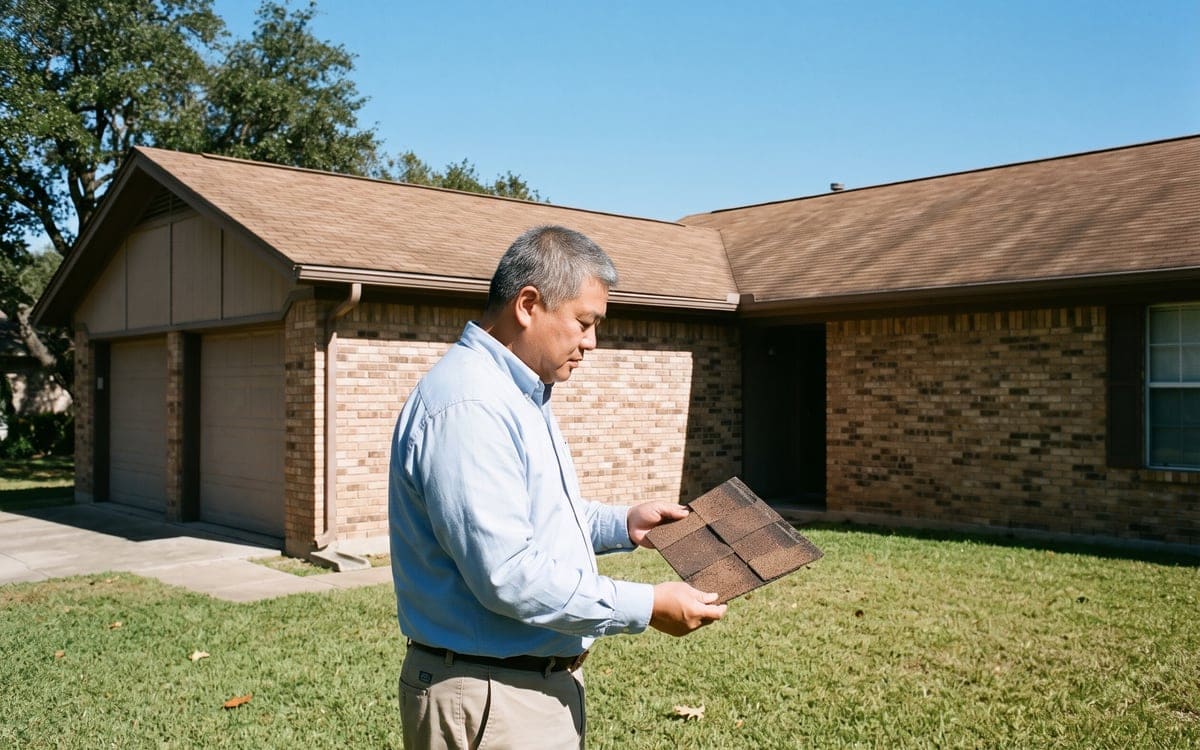
No single number fits every roof
The question has been researched. IBHS started its Roof Aging Farm program in 2013 to study how real roof systems age under weather and sunlight in different U.S. climates,1 and that program is still running.
For an Austin house the answer sits in the weather the roof has seen, the material the roof is made of, how it went on, and how the attic has handled heat and moisture. A roofer called in to look reads those together.
The material sets the starting point
An asphalt roof is a system of six components that work together: shingles, underlayment, ice and water barriers, starter strip products, hip and ridge products, and a balanced ventilation system,2 per ARMA's own description.
A standing seam metal roof is a different kind of system. Metal panels sort as structural (they span open framing and normally need no solid deck) or non-structural architectural panels, which need a solid deck,3 per the MCA's installer manual, and the metal may change size significantly on a regular basis, which is normal and has to be handled in the design and installation.3 Metal roof or shingles has the fuller comparison.
How it went on matters as much
Optimum shingle performance on the roof is equally dependent upon proper installation according to the manufacturer's installation instructions,4 ARMA writes. Nails improperly located or driven can lead to sealing failures, blow-offs, raised tabs and buckling.5
The 2021 model code says the same thing in code language: roof assemblies are designed and installed in accordance with the code and the approved manufacturer's instructions.6
Austin's sun and summer heat
Camp Mabry averages 122.8 days a year with a high of 90 degrees or more, 82.0 of them in June, July and August,7 and 28.7 days a year with a high of 100 degrees or more.7 Excessive heat on a residential roof speeds the aging of roofing materials.8
The heat is also what gets a shingle to seal: most asphalt shingles have a thermally activated sealant that bonds them together once they are on the roof and exposed to enough heat from sunlight.9 The covering's own defense against UV is the mineral granule on top, which gives the shingle color and protects the shingle's asphalt from the damage prolonged ultraviolet light would cause.10
Hail, and what it takes off a shingle
Of 274 Travis County hail reports of 1 inch or larger from 1996 to mid-2026, 216 came in March, April or May, with May the busiest month at 86.11 IBHS's own impact-resistant shingle ratings judge shingles on the damage seen in real hailstorms: dents, tears and granule loss.12 Owens Corning writes the follow-on: dislodged granules can prematurely age shingles, because without the granule coating shingles get more UV exposure and become more prone to warping and cracking.13
Roof hail damage covers what a roofer looks for after a Travis County hail day, and roof storm damage work covers the repair side.
In February 2023, trees gave out under the weight of ice buildup, falling onto cars, houses and electrical lines, with outages passing 200,000 customers in the Austin metro area,14 the Weather Service says. A limb through a roof is a sudden kind of failure, not a slow one.
Ventilation under the roof
What happens in the attic shapes what happens on top. Attic ventilation is an essential factor in the service life of the roof assembly materials, and overlooking it may result in premature roofing failure including blistering, buckling from deck movement, rotting wood and moisture in insulation,15 ARMA writes. The layout runs intake vents at the eaves or low on the roof, exhaust vents at the ridge or high on the roof, placed so air moves through all areas of the attic.16
Moisture can warp and damage the roof, render insulation useless and create moisture problems in the main living areas of the house,17 the U.S. Department of Energy writes.
| What wears a roof | What it does | What a roofer looks for |
|---|---|---|
| UV from the sun | Granules on the shingle protect the asphalt from UV; once they are gone, the asphalt gets more exposure (ARMA, Owens Corning) | Lost granules on the slopes |
| Hail | IBHS reads shingles on dents, tears and granule loss | Marks on soft metal (vents, gutters) and granules at the splash block |
| Trees on the roof | Branches rubbing against shingles can disturb the granules (Owens Corning) | Scuffed granules under branches, debris on the slopes |
| Clogged gutters | Water can back up underneath the shingles and overflow onto the siding or brick (Owens Corning13) | Water on the siding or brick below the eave |
| Poor nailing | ARMA: sealing failures, blow-offs, raised tabs and buckling | Buckled or raised shingles |
| Moisture in the attic | Overlooking attic ventilation may result in rotting wood under the covering (ARMA) | Wet or water-stained decking or attic flooring |
Signs a roof is wearing out, seen from the ground
From the ground or through upstairs windows where the roof surface can be seen, with binoculars as a good tool,15 the signs that read off a slope are granules at the splash block, lifted or missing tabs, dented vent caps and curled corners along the edges.
Inside, water stains on a ceiling can be the roof speaking, though ARMA notes that in cooler climates water stains may be due to condensation from inadequate attic ventilation rather than a leak through the roof.15 The attic from the hatch, without stepping in, is another look: wet or water-stained decking or attic flooring are reasons to pick up the phone. For the full version, a roof inspection in Austin is the next step. For a small patch of trouble on an otherwise sound roof, roof repair in Austin can hold the line. When the covering is past the point of patching, roof replacement in Austin takes it down to the deck.