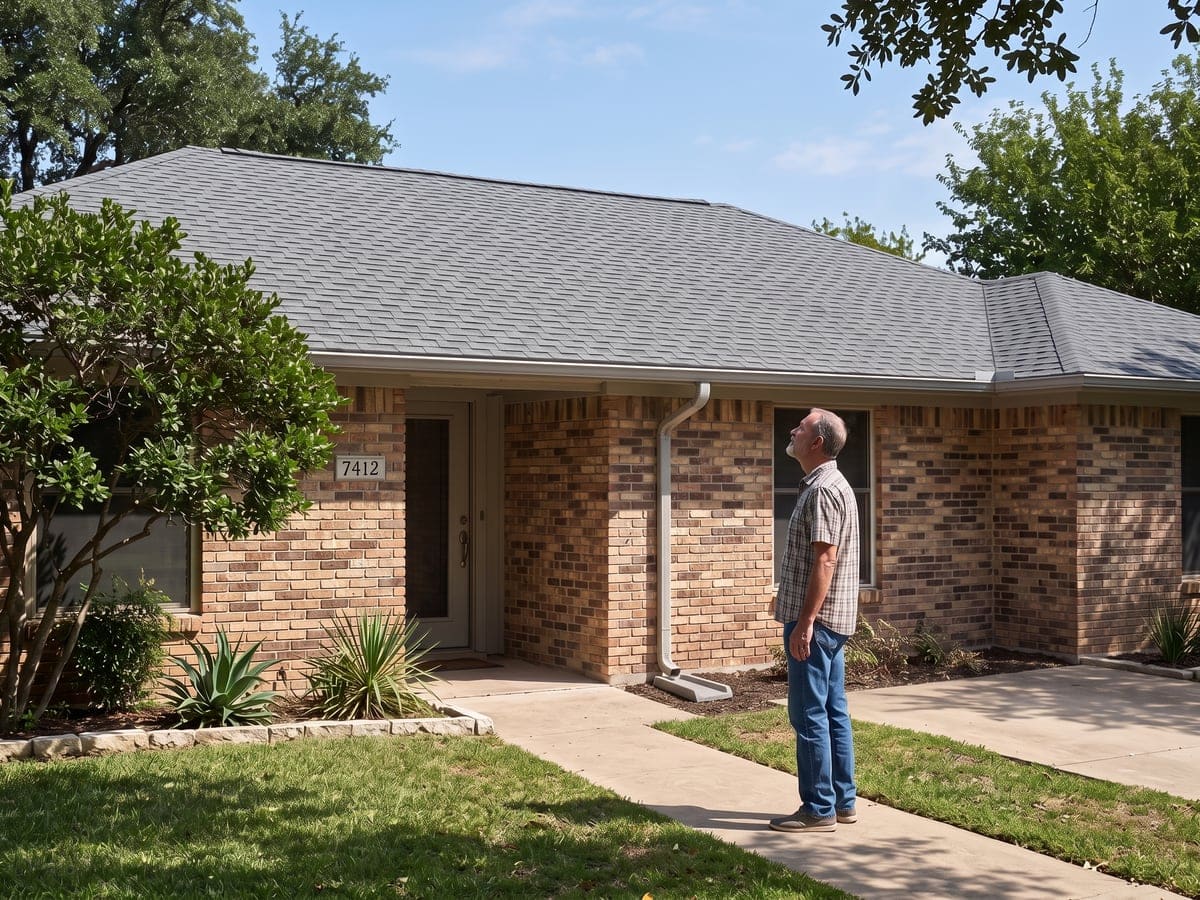
What a full replacement includes
A replacement reads from the deck up. ARMA says most codes define roof replacement as removing the old covering, repairing damaged substrate and installing a new covering,1 and roof recover as adding a covering over the existing one.
A roof replacement, from the deck up
The order the work follows, as the 2021 model code and the shingle makers' association describe it.
Off to the deck
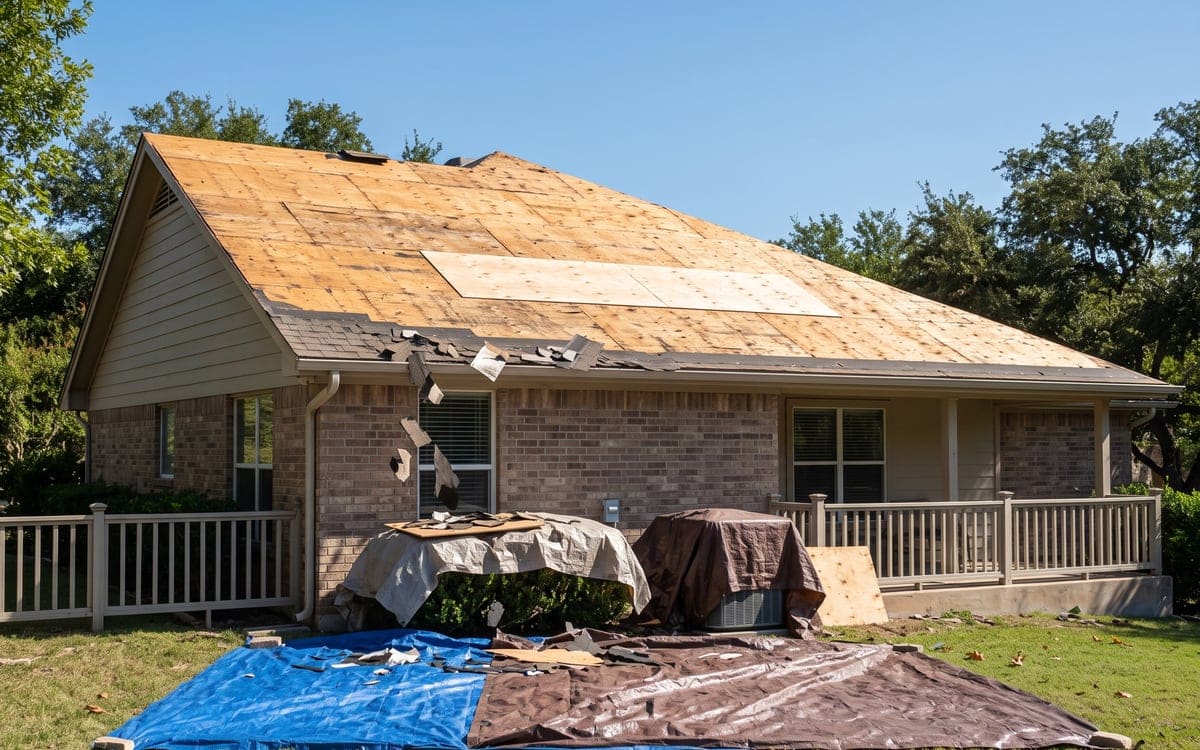
The old layers of roof covering come off down to the roof deck.
The deck is checked
Rotted, damaged, warped or delaminated sheathing is replaced.
Worn flashing is replaced
Flashings, edgings and vents that are rusted, damaged or worn are replaced.
Roof vents are renewed
Vents in the field of the roof, such as ridge vents, are replaced with the roof.
Sources: International Code Council (ICC), 2021 International Residential Code, Chapter 9 Roof Assemblies (codes.iccsafe.org); Asphalt Roofing Manufacturers Association (ARMA), Residential Asphalt Roofing Manual: Design and Application Methods (2014 edition); ARMA Technical Bulletin, Why Ventilation is Important.
1. Off to the deck, or a new layer over the old
The 2021 International Residential Code, a model code, says roof replacement includes removing the existing layers down to the roof deck.2 Most codes do not allow more than two roof coverings on a building,1 and most shingle makers do not recommend installing new shingles over existing laminated shingles.1 The 2021 IRC also says a recover is not permitted where the existing covering is slate, clay, cement or asbestos-cement tile, or where the roof already has two or more applications of any roof covering,3 and Atlas, a shingle maker, says it does not approve re-roofing over existing wood shingles or laminated asphalt shingles.4
2. The deck
Once the old covering is off, the deck gets a look. Before a reroof the deck is inspected to see whether it is sound,5 ARMA says, and rotted, damaged, warped or delaminated plywood or sheathing is replaced with approved material.
3. Drip edge, underlayment and starter strip
Then the layers under the shingles. Drip edge helps limit rot in wood6 when water gets under the shingle edge, and shingles should not be installed directly on a wood deck:7 underlayment goes on first. The starter strip protects the deck from wind-driven rain under the joints of the first course5 and keeps that course from peeling in high wind.
4. Flashing and vents
Flashings get reused only where they are sound. When a roof is recovered or replaced, flashings, edgings, outlets, vents and similar devices are replaced where rusted, damaged or deteriorated,2 the 2021 IRC says. On a reroof the flashing around pipe penetrations is examined,5 and if it has deteriorated, new flashing goes in.
5. The new covering
Then the covering goes on. Strip shingles are typically rectangular with cutouts that separate the tabs, while laminated shingles are made of one or more layers of tabs5 that give greater thickness. Metal panels, tile and other coverings each have their own order; a metal roof covers that install.
6. Ridge, ventilation and the finish
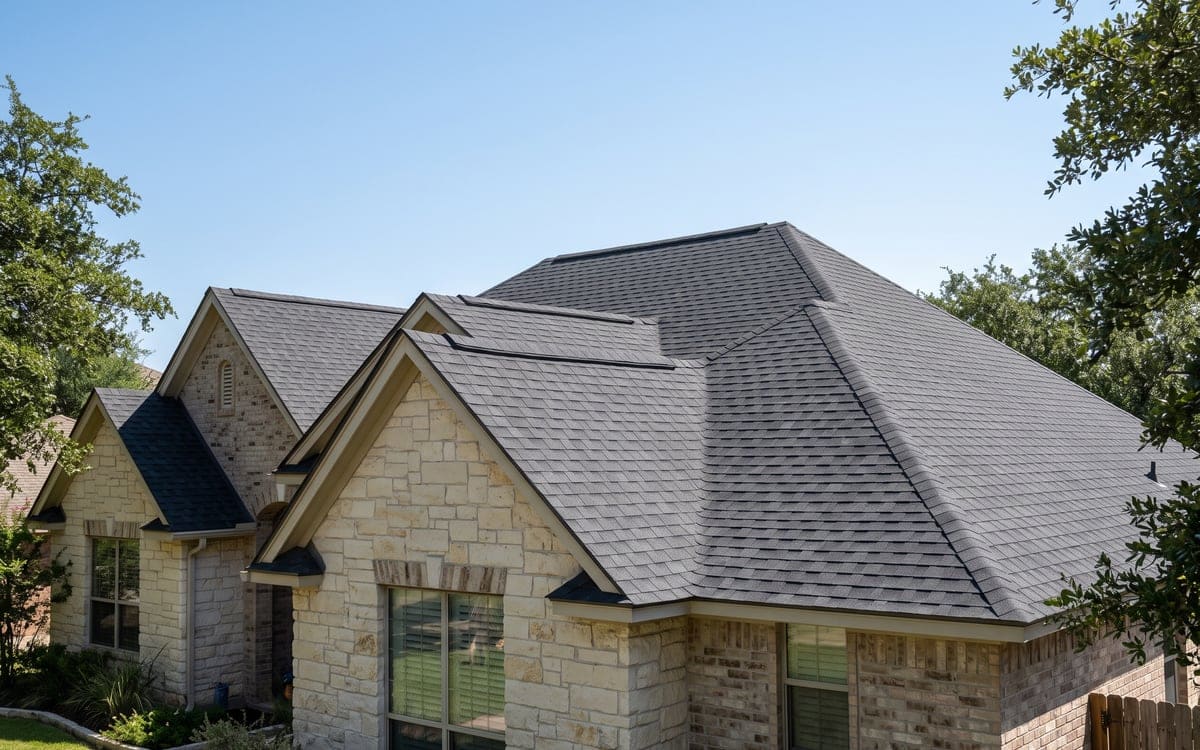
Last come the top-of-roof pieces. When a roof is reroofed, static vents and ridge vents are replaced8 while soffit or gable vents outside the field can stay. Then the ridge caps go on and the job gets a close look.
| Symptom | Likely cause | What it usually needs |
|---|---|---|
| Curled or cracked shingles on most slopes | Wear across the whole roof | A replacement talk |
| Dents, tears or lost granules across the shingles | Hail | A full look, then repair or replacement |
| Two layers of shingles already | An earlier overlay | A tear-off to the deck |
| Sagging between rafters | A deck or framing problem | A look at the deck first |
| Daylight through the deck from the attic | Gaps or damaged sheathing | Deck repair as part of the job |
The City's permit line for replacing a roof
Austin writes its own line. The City says replacing asphalt shingles with asphalt shingles does not need a building permit, unless the property is in the Wildland-Urban Interface area and 50 percent or more of the roofing is being replaced.9 The same exemption covers any roof covering that does not adversely affect the roof structure,9 with the same WUI exception. Replacing roof decking of 128 square feet or less is also exempt;9 above that, Development Services says a roof job goes on a Residential Express (Minor Repairs) permit.10
The City's line for a roof replacement
As Development Services and Austin Fire word it.
Asphalt over asphalt
- No building permit needed
- Unless the property is in the wildfire area and 50 percent or more is replaced
In the wildfire area, 50 percent or more
- A Residential Express permit when over 50 percent is replaced
- The whole covering is replaced
- With a Class A covering
- Metal or woven valleys, flashing visible
Sources: Austin Development Services, Work Exempt from Building Permits; Austin Development Services, Express Permits (Residential Express, Minor Repairs); City of Austin Ordinance No. 20250410-041 (2024 International Wildland-Urban Interface Code and local amendments, City Code Chapter 25-12, Article 8); Austin Fire Department, Wildland-Urban Interface Code.
The Wildland-Urban Interface rule changes the scope. The City's WUI code (Section 507.1, as amended) says replacing 50 percent or more of a roof covering requires replacing the whole covering, to the standard for new construction.11 What 507.1 names is the covering itself: a Class A rated covering, with gaps fire-stopped or covered with an approved cap sheet,12 and metal or woven valleys with the flashing visible for inspection.12 For construction in the WUI zones, Austin Fire's page also lists noncombustible gutters with leaf guards12 and ember mesh on attic vents12 under separate sections. More than half of Austin falls into one of three WUI zones,12 and Austin Fire says the WUI code applies even when no permit is needed.12
The City's interactive map is the starting point for whether a property sits in a zone, and Austin Fire says Zones A and B are confirmed on site by measuring to the nearest wildland. The City is the authority for an address.
When a replacement makes more sense than a repair
Signs that point to a replacement
ARMA says the shingles will likely need to come off if there are two layers, the structure sags across the ridge or truss lines, the deck has rotted or warped wood or large gaps, or the old shingles are too uneven for the new roof to lie flat.1
When a repair fits
ARMA also says if the roof has only one layer that lies flat and the deck is in good condition, replacement may not be necessary.1 Damage in one area, a cracked pipe boot, loose flashing or a few lifted shingles are usually a repair, not a replacement. For a known drip, an inspection first is a better call.
Picking the new roof
The choices are shingle, metal and tile. IBHS says asphalt shingles are about 80 percent of installed residential roofs13 in the United States. For the full comparison, metal or shingles is on its own page, and a metal roof covers the metal install. Impact-rated shingles sit alongside standard shingles as a label from the makers.
HOA and historic district rules
Property Code Section 202.01114 covers one case: an owner whose HOA already allows shingles on the roof wants shingles that are mainly wind and hail resistant, more energy efficient than customary composite shingles, or solar generating. In that case the HOA cannot prohibit or restrict them, so long as once installed they resemble the subdivision's authorized shingles, are more durable and of equal or superior quality, and match the look of the surrounding properties.
For a historic landmark or a contributing building in a local historic district, the City's Historic Design Standards say replacing roof material requires historic review, except for in-kind replacement.15 The City also says routine maintenance and in-kind repairs do not need historic review.16 The Historic Preservation Office decides.
The visit for a replacement
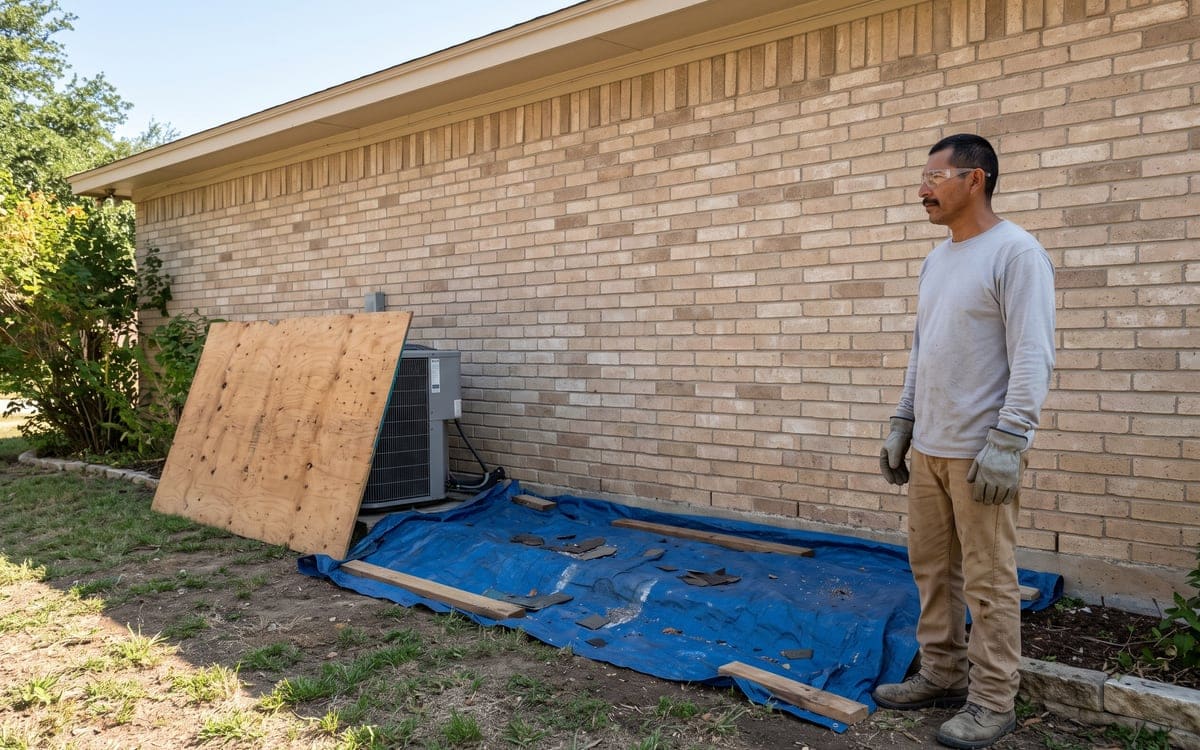
On a replacement visit, our roofer looks at the whole roof, the attic from the hatch and the ceilings underneath. ARMA lists tarps among a roofing job's tools, used to cover shrubs and the landscape.5
Replacing a roof in Austin's climate
Austin asks a lot of a roof. Camp Mabry's normal summer high is 95.9 degrees,17 and hot-day installs ask for extra care. Hail is the other side. NOAA's Storm Events Database holds 274 Travis County hail reports of 1 inch or larger from 1996 to mid-2026.18 A replacement in Austin lives with that, which is where impact-rated shingles come into the picking conversation. ARMA says the ability to resist impacts interests many homeowners but is not required by the building codes.19