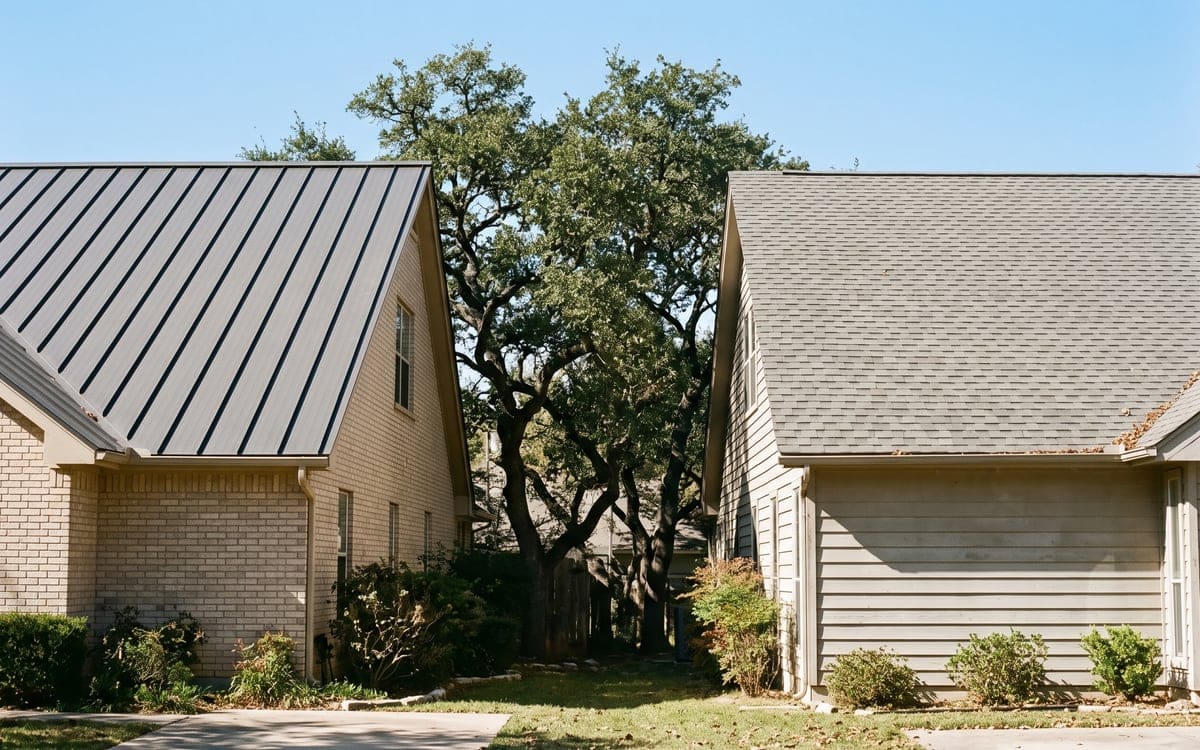
Shingles are still the usual roof
ARMA says asphalt shingles continue to be the most popular choice for residential roof coverings in North America,1 and IBHS says asphalt shingles are about 80 percent of installed residential roofs in the U.S., and are frequently damaged in hail and high-wind events.2 Metal panels sit between a product choice and a different roof system.
How each one goes on
Each roof is a system more than a single product. A shingle roof lays overlapping courses from the eave up, over metal drip edge and underlayment on a solid deck. Most shingles have a factory-applied self-sealing adhesive that is activated by the heat of the sun after the shingle is on the roof, and bonds each shingle to the one below for wind resistance,3 ARMA says.
Shingles and metal side by side
What the trade groups say about each.
Asphalt shingles
- The most popular residential roof in North America, ARMA says
- Impact ratings run from Class 1 to Class 4
- Laid in overlapping courses
Metal
- Most metal roofing is Class A for fire, its makers' group says
- Rain noise differs little from other roofs, the same group says
- Panels grow and shrink with heat
Sources: Asphalt Roofing Manufacturers Association (ARMA), Asphalt Shingle Product and Test Standards; Metal Roofing Alliance (MRA), Fire Performance (metalroofing.com); Metal Roofing Alliance (MRA), FAQs (metalroofing.com); Metal Construction Association (MCA), Metal Roof Installation Manual (installer training manual; Internet Archive copy of the file McElroy Metal hosted).
A metal roof uses vertical panels or modular units on a sound deck. In a standing seam roof, concealed clips sit along the panel edges and do not pierce the panel, so the main roof surface shows no fasteners except at the eave.4 Modular panels, made to simulate asphalt, slate, wood or clay,4 use their own clips or screws; stone-coated steel is one of these modular panels.
| Question | Shingles | Metal |
|---|---|---|
| How it goes down | Overlapping courses, nailed | Panels or modular units, clipped or screwed |
| What is under it | Solid deck, underlayment, drip edge | Solid deck for architectural panels, underlayment, slip sheet in heat |
| What seals the roof | Shingle courses and the self-seal strip | Panel seams and the trim at every edge |
| What moves on the roof | ARMA says each shingle bonds to the one below once the sun activates the sealant | Panels grow and shrink with heat |
| Where leaks tend to start | Flashing, valleys, pipe boots | Fasteners, end laps, flashing transitions |
What summer sun and heat do to each
Camp Mabry averages 122.8 days a year with a high of 90 degrees or more, with 82 of those days in June, July and August.5 On a shingle roof the sun's heat is what seals the shingles together; on a metal roof the same heat is what makes the panels move. Metal roof panels may experience significant size changes on a regular basis, which is normal and has to be handled in the design and installation,4 the MCA manual says. A metal roof built right pins each panel at one point so it can move elsewhere; a shingle roof built right has the right offsets and nails to stay put. Both ask the roofer to plan around the heat.
What hail does to each
IBHS says hail can strike anywhere strong thunderstorms form, and is a major risk to homes, roofs and businesses across the U.S.6 For asphalt shingles, impact ratings run on a four-step scale. ARMA says the UL 2218 test drops steel balls from 12 to 20 feet onto a deck of shingles, and the shingles are rated into Class 1 through Class 4, with Class 4 the highest.1 ARMA also says the ability to resist impacts is of interest to many homeowners but is not required by the building codes,1 so a Class 4 label is a product choice, not a code floor.
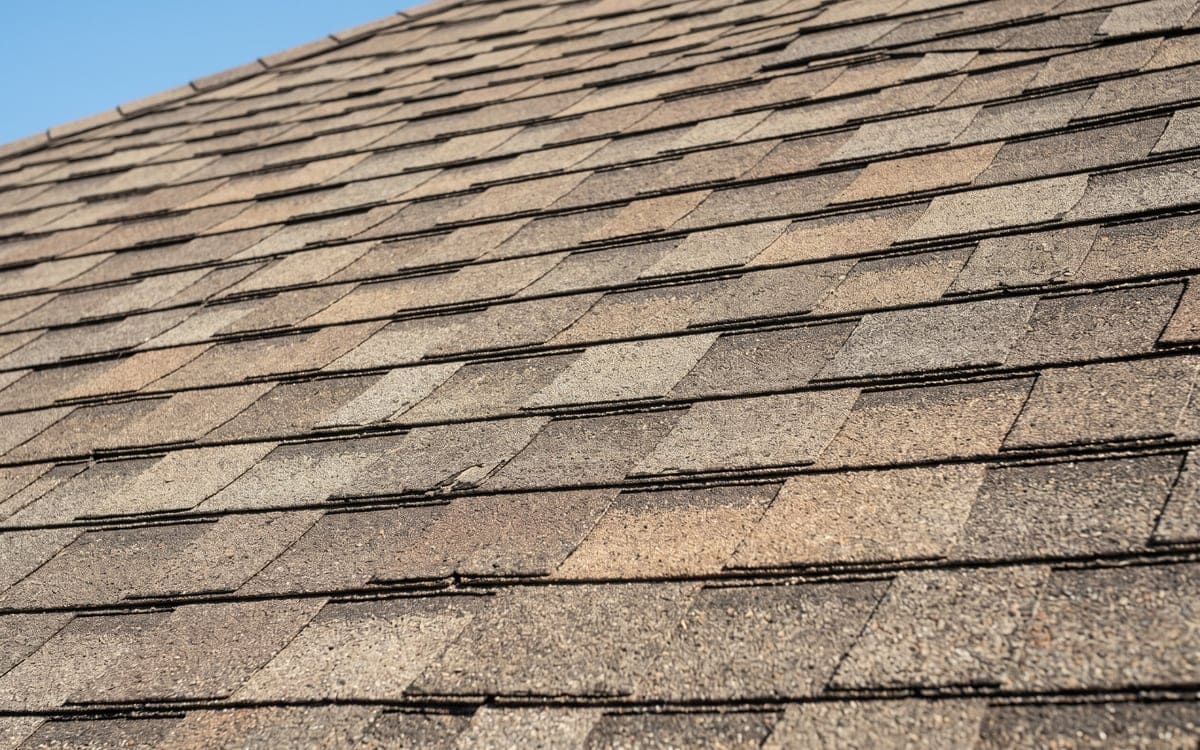
IBHS has gone further. In its 2025 round of testing it tested a record 24 impact-resistant shingle products, about 95 percent of that market, and while most earned Good, none earned Excellent.7 It rates them Excellent, Good, Marginal or Poor, and does not recommend a product rated Marginal or Poor in areas that get hail.7 Austin gets hail: Travis County carries 216 reports of hail 1 inch or larger in March, April or May from 1996 to mid-2026.8
The Metal Roofing Alliance says many metal roofing products carry the highest impact resistance and hail rating given by UL, and that hail will typically not penetrate a metal roof.9 Hail still dents panels. For either material, the storm damage page and a look on the roof decide what the hail did.
Fire ratings and Austin's wildfire areas
In an Austin wildfire zone the covering has to meet the City's rules. Austin Fire says all three Wildland-Urban Interface zones need a Class A rated roof covering, with gaps fire-stopped or covered with an approved cap sheet,10 and that a Class A roof assembly is the highest fire rating; once a covering is chosen, the maker should confirm the underlayment, insulation and sheathing are enough for the Class A rating.10 Both shingles and metal can be built as Class A assemblies; the roof as a whole has to pass, with the shingle or panel one piece of what is tested.
The Metal Roofing Alliance says most metal roofing carries a Class A fire-resistant rating.11 For shingles, NRCA says the U.S. product standard ASTM D3462 sets a minimum Class A fire rating and the model codes reference it as a minimum.12 Austin Fire says even if a permit is not needed, the work still must follow WUI Code requirements.10 More than half of Austin falls into one of three WUI Code zones;10 the City's Interactive WUI Code Map is a starting point, with Zones A and B confirmed on site.10
HOAs, historic districts and the look of the street
Who approves the material matters as much as the material. Texas law speaks to HOAs on the shingle question. Section 202.011 of the Property Code says a property owners' association may not prohibit or restrict an owner otherwise authorized to install shingles from putting on shingles made primarily to be wind and hail resistant, more energy efficient than customary composite shingles, or solar generating.13 Those installed shingles have to resemble the shingles the subdivision authorizes, be more durable than them and of equal or superior quality, and match the look of the surrounding properties.13 The statute covers a certain class of shingles; it does not say an HOA has to approve a metal roof, so an HOA's own documents answer the metal question. Read your HOA's rules first, and a lawyer answers the specific case.
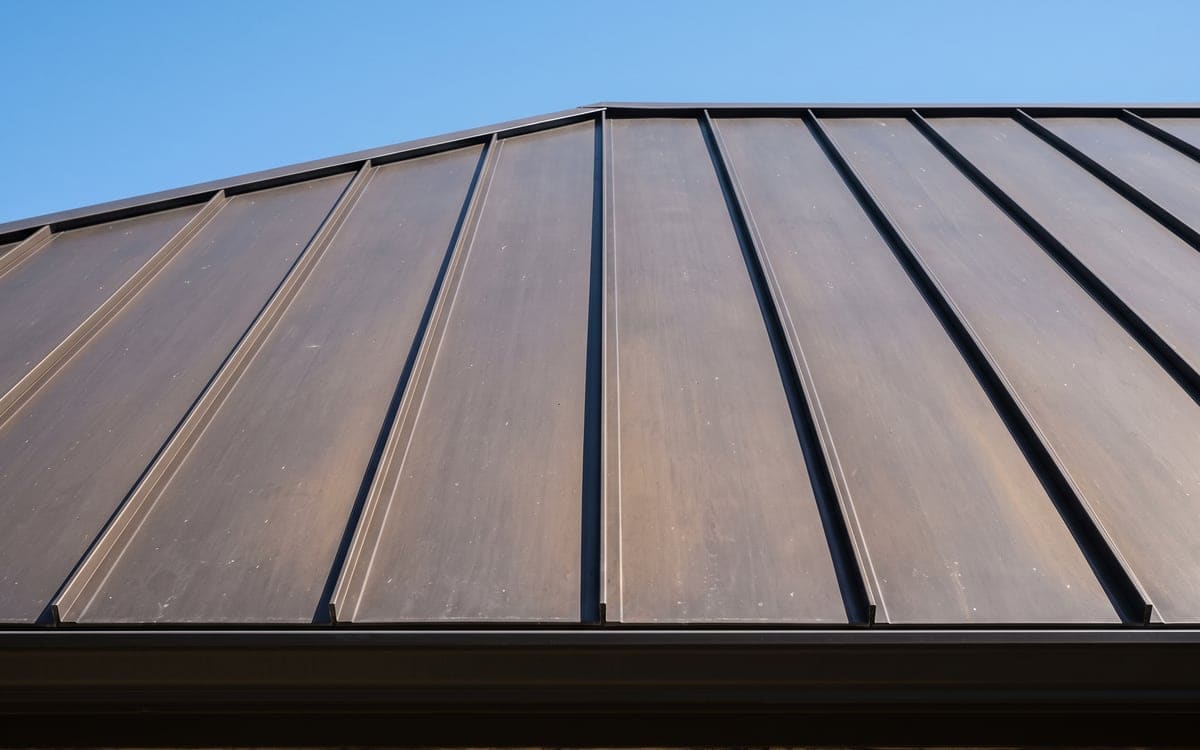
For a historic landmark, or a contributing building inside a local historic district, the City's Historic Design Standards require historic review to replace roof materials on a historic building, except for in-kind replacement.14 A change from one roof material to another still goes through review. The same standards say fiberglass or composition roofs are acceptable if they approximate the historic roof material, and metal roofs are acceptable in historic districts unless a district supplement says otherwise.14 On a landmark, they say standing seam metal roofs are generally not acceptable, unless the owner can document that the building historically had one.14 The Historic Preservation Office decides the specific case.
What decides it for your house
Price moves on the roof itself and what the covering costs. The Metal Roofing Alliance says the shape and pitch of the roof influence the installed cost of a metal roof more than the style of metal chosen, along with the staging area, material storage, hips and valleys.15 On the shingle side, what moves the price is the roof's shape too, plus layers of shingles to take off, deck repairs that come to light, and the shingle you pick. The 25 percent rule people cite online is a Florida rule; the Austin version is a different line, with the WUI code on top of it.
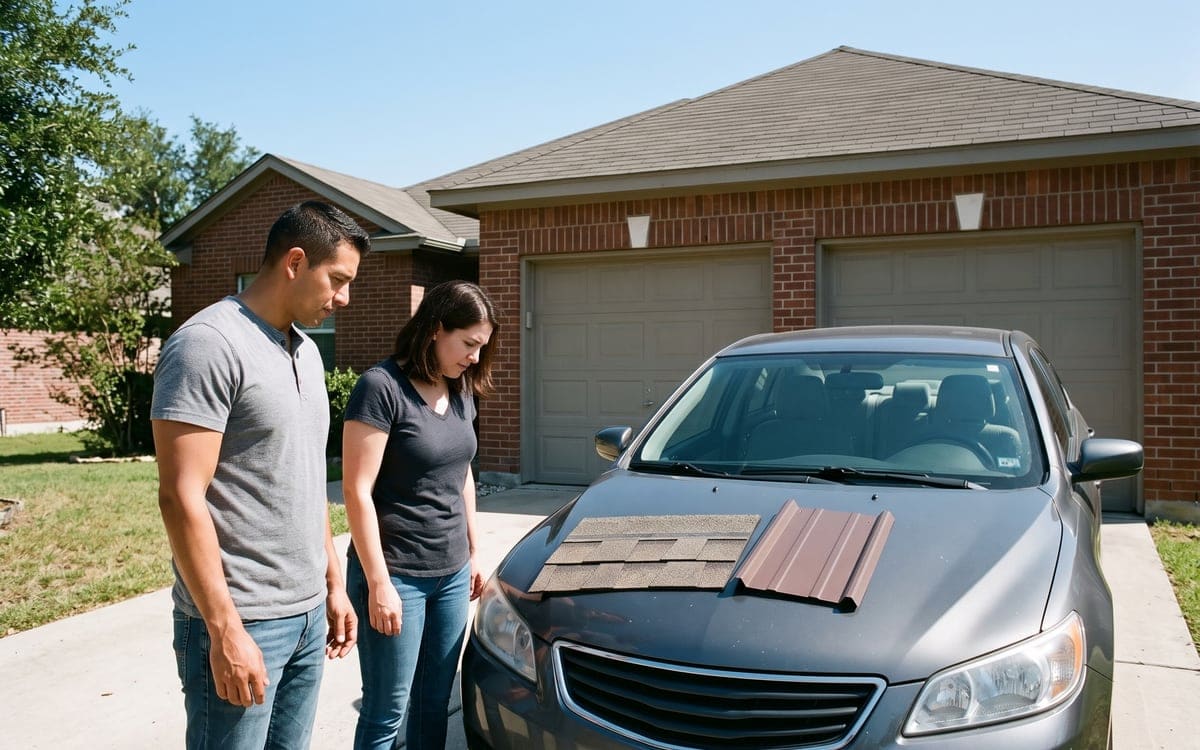
Beyond price, the pick usually turns on the house itself and the street it sits on, the rules the house carries (an HOA, a historic designation, a WUI zone), and the look the owner wants to see from the driveway. A new metal roof or a shingle replacement each start the same way, with a look at the roof and a plan for the one you want. On a new build, the roof installation page covers the layers from framing up.