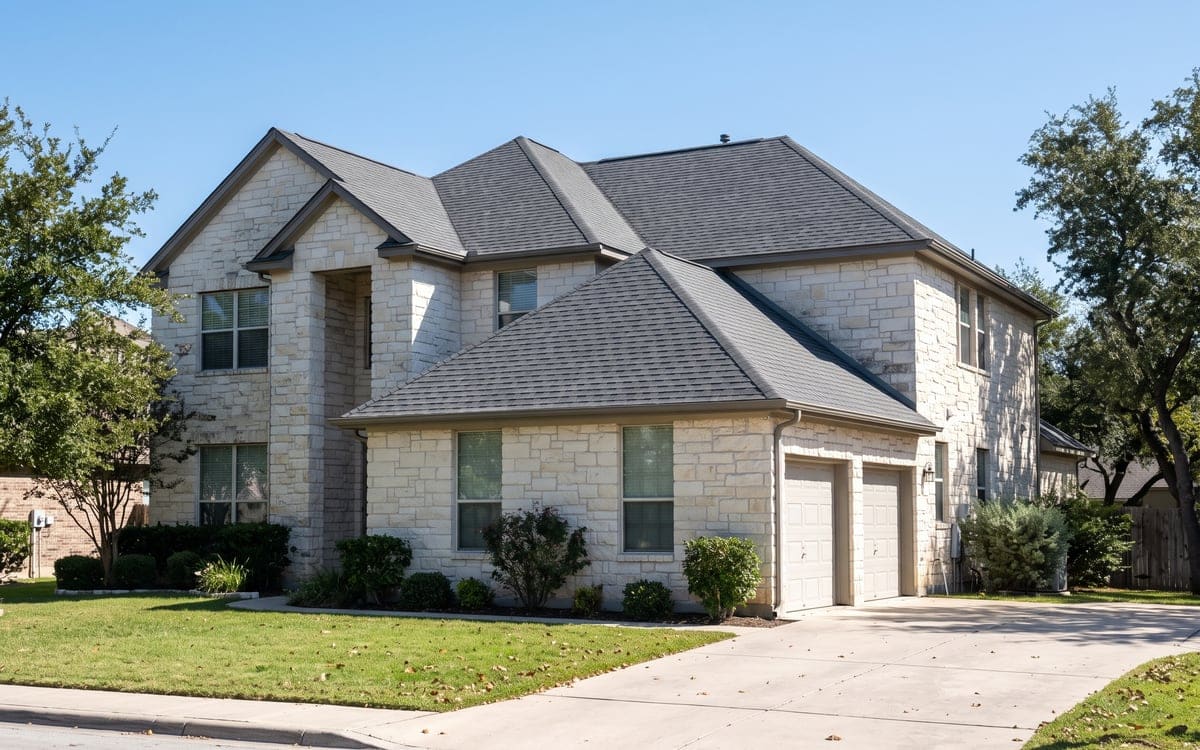
The price follows the roof
A worked-out price starts with a measurement of the roof and a look at what is under the covering. Two houses that look alike from the street can carry very different prices once a roofer counts the valleys and checks the deck under the shingles.
What moves the price of a new roof
The things a roofer sizes up before giving a price.
The roof itself
- Size, measured in squares
- Valleys, dormers and hips that add trim waste
- A low slope that needs more underlayment
What is under it
- Layers to tear off
- Rotted deck to replace
What goes on it
- Shingle, metal or tile
- For metal, the roof shape and pitch
- Rules that set the materials
Sources: Asphalt Roofing Manufacturers Association (ARMA), Residential Asphalt Roofing Manual; ARMA, Steep Slope Roofing Underlayment; Metal Roofing Alliance, FAQs; City of Austin Ordinance No. 20250410-041 (2024 Wildland-Urban Interface Code, local amendments).
Roofers count the area in squares; 1 square equals 100 square feet,1 per ARMA's residential manual. On top of the measured area, most jobs need 2 to 10 percent extra shingles for trim waste, depending on how many valleys, dormers, hips and roof penetrations the roof has,1 so a simple gable with two slopes needs less and a cut-up roof with many planes needs more.
Size and pitch come first
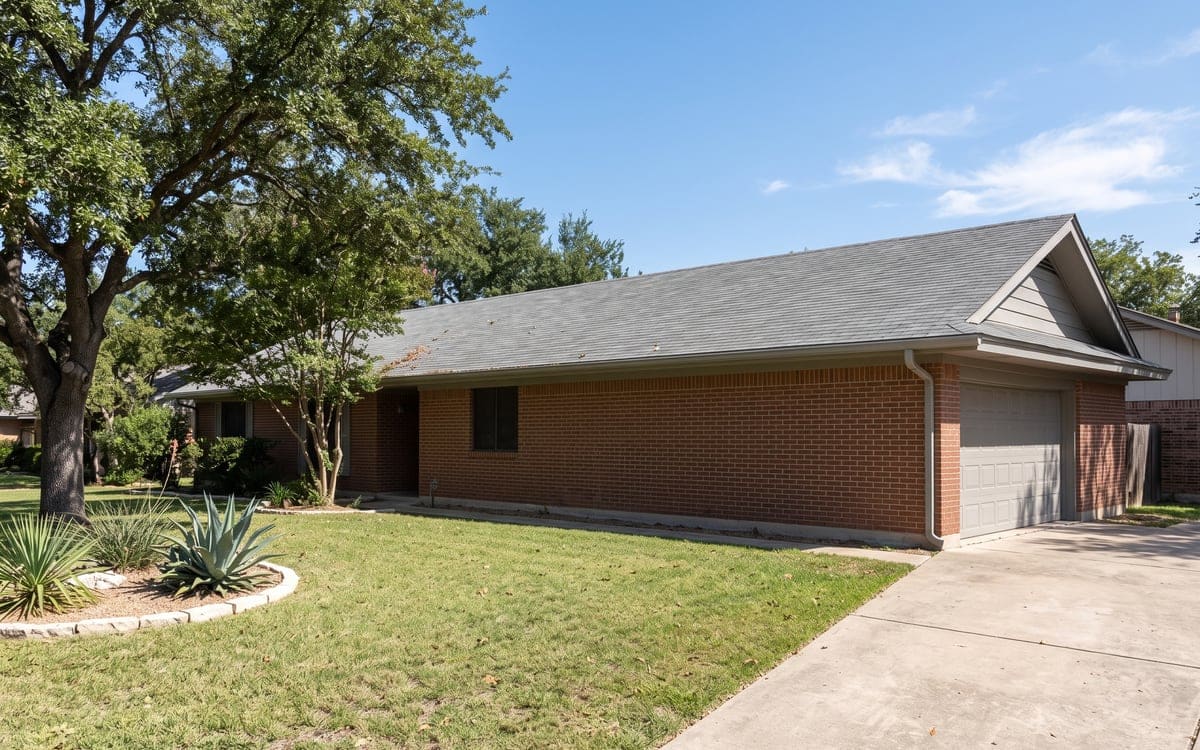
Square footage is the first lever; pitch is the second. Roof slope is the vertical rise in inches for every 12 inches of horizontal run,1 so a 4-inch rise per foot is a 4:12 slope. Standard installation methods for asphalt shingles run from 4:12 to 21:12,1 with low-slope procedures from 2:12 up to 4:12 and special steep-slope procedures above 21:12. A low slope also adds underlayment, since codes require a double layer of mechanically fastened underlayment, or one layer of self-adhering, on slopes of 2:12 up to 4:12.2
A cut-up roof with many planes carries more trim waste, more valleys and more flashing than a simple two-slope gable.
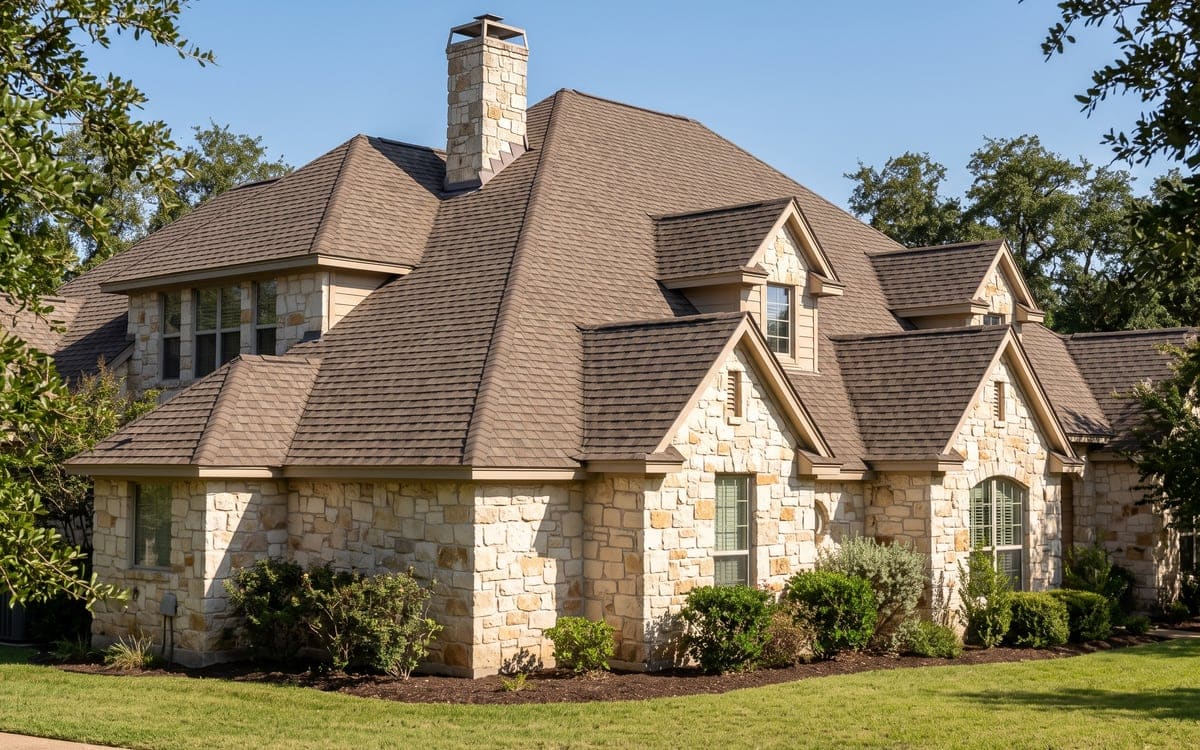
What is under the shingles changes the job
A tear-off is one price; a tear-off plus deck repairs is another. Roof replacement includes removing the existing layers of roof covering down to the roof deck,3 the 2021 model code says. Once the old shingles come off, the sheathing shows, and rotted, damaged, warped or delaminated plywood or sheathing is replaced with approved material1 per ARMA's manual; a deck that has deteriorated to the point that it will not hold new fasteners should be replaced1 too.
Austin draws a permit line through this part of the job. Replacing roof decking of 128 square feet or less is exempt from a building permit,4 Development Services says. Above that, a Residential Express (Minor Repairs) permit applies.5 Attic ventilation is checked at the same time, since a reroof includes a check that the existing attic ventilation is adequate.6
The material you pick
Shingles, metal and tile all do the same job in different ways and at different prices. For metal, the shape and pitch of the roof influence the installed cost more than the style of metal chosen,7 with staging area, material storage, hips and valleys also mattering; how a metal roof is installed depends greatly on the size, pitch and complexity of the existing roof structure,7 the Metal Roofing Alliance says.
Within shingles, there is a second choice: a plain architectural shingle or an impact-rated one. IBHS tests impact-resistant shingles with laboratory-made hailstones, which it says gives a more realistic measure of damage than traditional steel balls,8 and rates them Excellent, Good, Marginal or Poor; IBHS does not recommend a product rated Marginal or Poor in areas that get hail,8 which Austin is. A matching hip and ridge product is typically a separate matching product from the field shingles,1 so it is a separate line item.
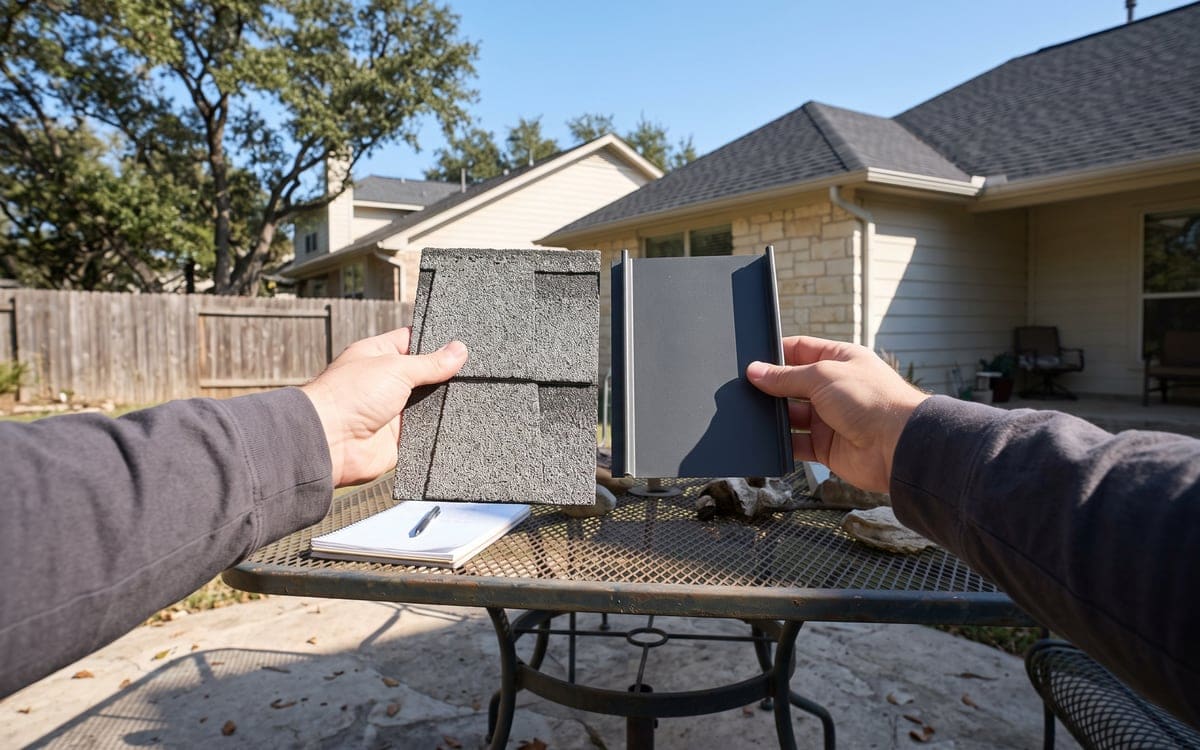
The material you pick for a new roof is a conversation worth having before you compare prices.
Flashing, vents and the edges
A roof's edges carry drip edge, starter strip, valleys, ridge and the boots around each pipe. When a roof is recovered or replaced, existing flashings, edgings, outlets, vents and similar devices that are part of the assembly are replaced where rusted, damaged or deteriorated3 and reconstructed to the manufacturer's instructions, per the 2021 model code. The flashing around a pipe penetration is examined on a re-roof, and if it has deteriorated the old flashing comes off and new flashing is installed.1
Austin's wildfire-area rule can change the scope
Austin has a WUI code, written by the City and listed by Austin Fire. Under that code, replacing 50 percent or more of a roof covering requires replacing the whole roof covering, to the standard for new construction.9 The 50 percent rule points to Section 504.2, so the new standard is a Class A rated roof covering, with gaps fire-stopped or covered with an approved cap sheet,10 and Section 504.2.1 inside it puts valleys on the same list: metal flashing or a woven (closed) valley, with the flashing visible for inspection.10
Austin Fire lists two more zone requirements as separate sections. Gutters and downspouts must be noncombustible with noncorrosive, noncombustible leaf guards,10 and attic vents must be covered with noncombustible, corrosion-resistant mesh with openings of 1/8 inch or less.10 Austin Fire adds that existing buildings in Austin's WUI do not have to be updated to the current code; the 2024 version applies to new construction or development.10
The City's permit page states one side of the covering rule in its own words: asphalt shingles that replace existing asphalt shingles need no permit, unless the property is in the Wildland-Urban Interface area and 50 percent or more of the roofing is being replaced.4 More than half of Austin falls into one of three WUI zones (A, B and C), Austin Fire says. The City's interactive WUI map is the starting point, and Austin Fire says Zones A and B are confirmed on site by measuring to the nearest wildland.
How to read two prices side by side
Two quotes from two companies may cover different scopes. Compare them line by line, not to pick the lower number but to see what each one includes before anyone starts tearing shingles off.
| What moves the price | Why it matters | What to ask about it |
|---|---|---|
| Roof squares and pitch | A bigger roof needs more material; a steeper pitch needs special installation methods per ARMA | How many squares the roof holds, and what pitch |
| Roof complexity | Valleys, hips and dormers add trim waste and more flashing | How many valleys and penetrations are counted |
| Tear-off and layers | The 2021 model code defines replacement as removing layers down to the deck | How many layers come off, how disposal is handled |
| Deck repairs | ARMA says rotted, warped or delaminated sheathing is replaced | How deck boards past 128 square feet are handled |
| Material and rating | Shingle, metal or tile; a plain or impact-rated shingle | What product, what rating and how the ridge is finished |
| Flashing and vents | The 2021 model code says flashings are replaced where rusted, damaged or deteriorated | Which flashings are new, which are reused |
| WUI scope | In a wildfire area, 50 percent or more of a covering means a full covering replacement | Whether the price covers a full-covering replacement if the WUI line is crossed |
For a smaller fix, our roof repair in Austin page covers that end. A roof inspection is one way to sort which scope applies. If hail is part of the story, roof storm damage work covers what a hail check looks like after a spring storm.