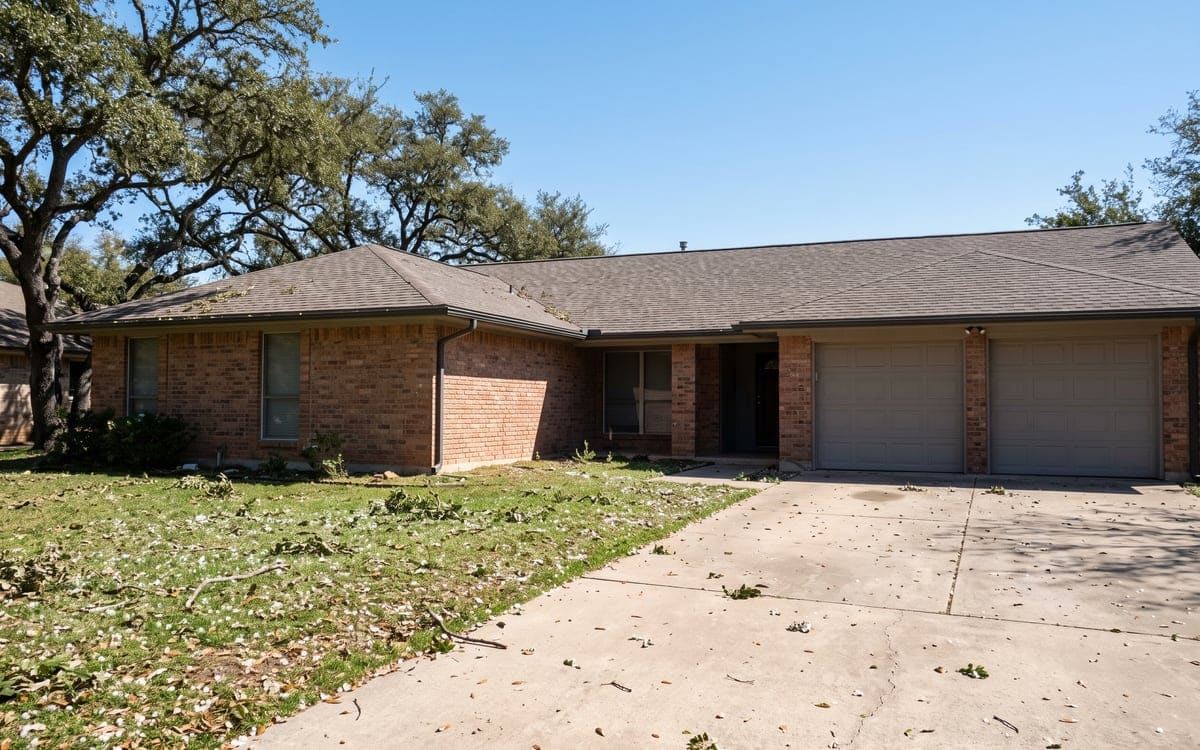
Hail is the Austin roof story
Travis County has a long record of hail. The NOAA Storm Events Database counts 383 hail report rows for Travis County from 1996 to mid-2026, and 274 of them are for hail 1 inch or larger1 (reports, not separate storms).
Of those 383 rows, 105 are for hail 1.75 inches or larger, 54 for 2 inches or larger and 6 for 3 inches or larger;1 the largest in the record is a 4-inch report at Mueller Airport on May 14, 2008.1 IBHS says hail can strike anywhere strong thunderstorms form and is a major risk to homes, roofs and businesses across the U.S.2
Most of it falls in spring
Austin's hail season runs with the severe weather season, March through May, when most severe weather comes as large hail and strong winds.3 Of the 274 reports of 1 inch or larger, 216 came in March, April or May, with May the busiest month at 86.1
How often hail of 1 inch or more reaches Travis County
From NOAA's Storm Events reports, 1996 to mid-2026.
Reports of hail 1 inch or larger spread over 77 separate dates,1 with hail of that size reported in 28 of the 31 years from 1996 to 2026.1 The top three hail storms to hit Austin have all occurred on a March 25th, in 1993, 2005 and 2009,1 per NOAA; the 2009 one brought hail from quarter to teacup size, with 14 severe hail reports, nine of them 2 inches or larger, and teacup-size hail near the Arboretum.1 Another March 25, in 2021, ran through central and northeast Austin with quarter to lime size hail.4
September rarely gets hail, but on September 24, 2023, a storm dropped hail of 1.5 to 2.25 inches in Austin along and just west of I-35,5 with egg to baseball size hail reported as the storm moved over north-central Austin.5 The next spring, April 9, 2024, a thunderstorm dropped hail up to tennis ball size near MoPac and Far West Boulevard in northwest Austin.1
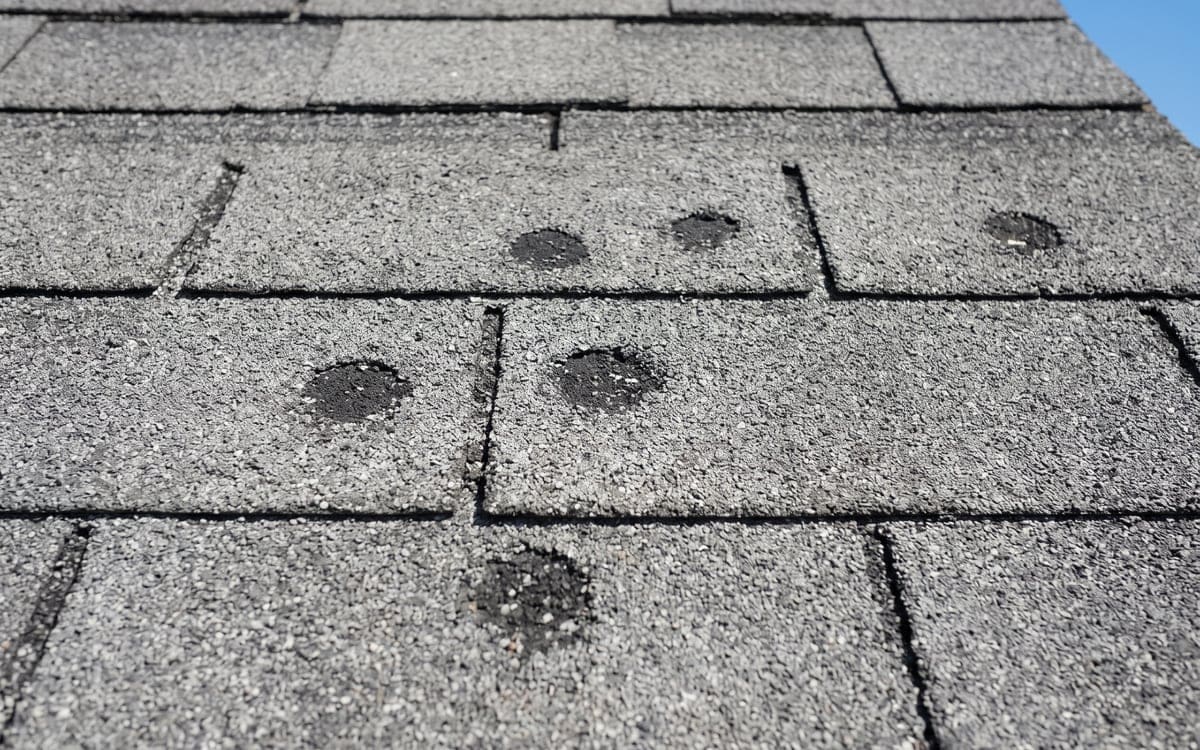
What a hailstone does to a shingle
An asphalt shingle is a fiberglass mat set in asphalt, surfaced with mineral granules that take the sun and protect the mat. IBHS, which runs its own impact-resistant shingle tests, judges hail damage on three modes: dents, tears and granule loss.6 Those are the marks a roofer reads on the slopes.
Owens Corning writes about the wear side: once granules are gone, shingles get more UV exposure and become more prone to warping and cracking.7 ARMA says a shingle-roof inspection checks for broken, torn or damaged shingles.8 The call either way is a roofer's.
Metal, tile and the soft metal on every roof
Metal panels and tiles take hail differently from shingles. On metal, the Metal Roofing Alliance says many metal roofing products carry the highest impact resistance and hail rating given by UL, and that hail will typically not penetrate a metal roof.9
On tile, the TRI Alliance says replacement tiles must interlock and seat with the existing ones or they can cause leaks and breakage,10 and that tiles may be harvested from another roof plane. A roofer's look decides what a hailstorm did to a tile roof.
The soft metal on a roof shows hail from the ground. The 2009 Austin storm's event narrative says plainly: large hail shredded leaves, put dents in cars and gutters.1 Dents on a gutter or a vent cap seen from the yard are signs to look for.
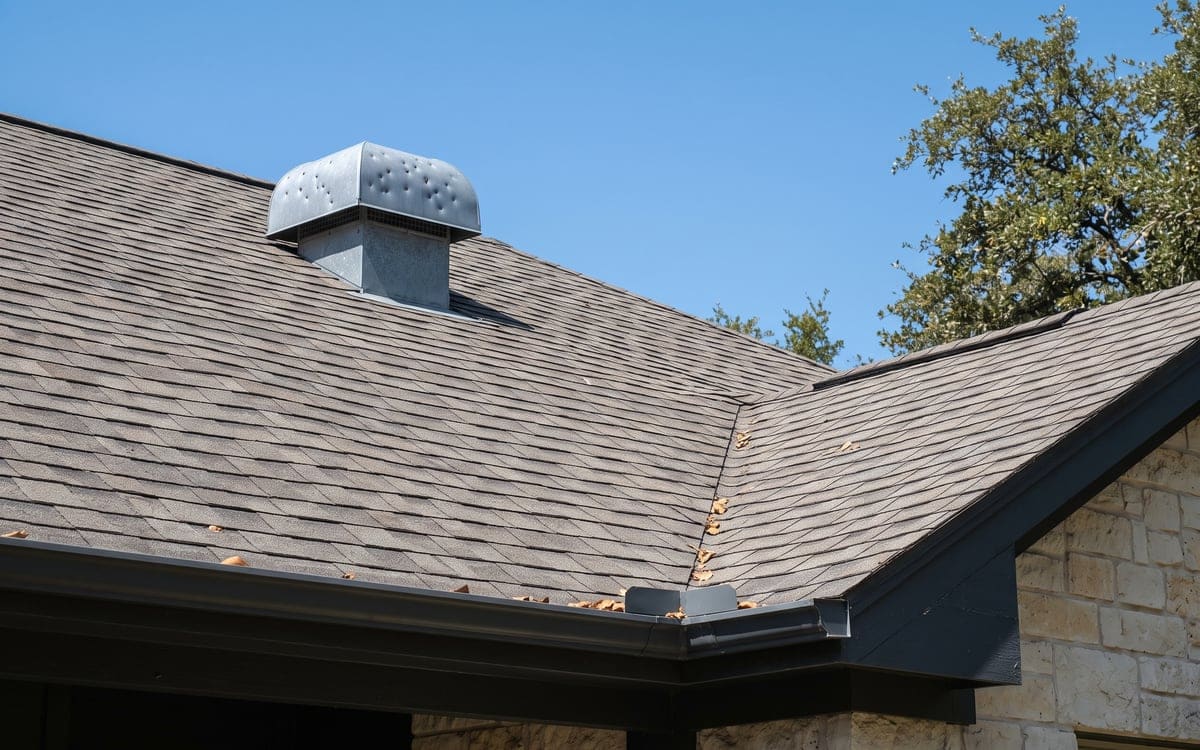
What you can see from the ground
Nobody should be on the roof after a hailstorm; workers do not stand on steep roofs, greater than 4 in 12, without conventional fall protection systems,11 OSHA says, and homeowners should assess roof damage from ground level and not attempt repairs on their own,12 per NRCA.
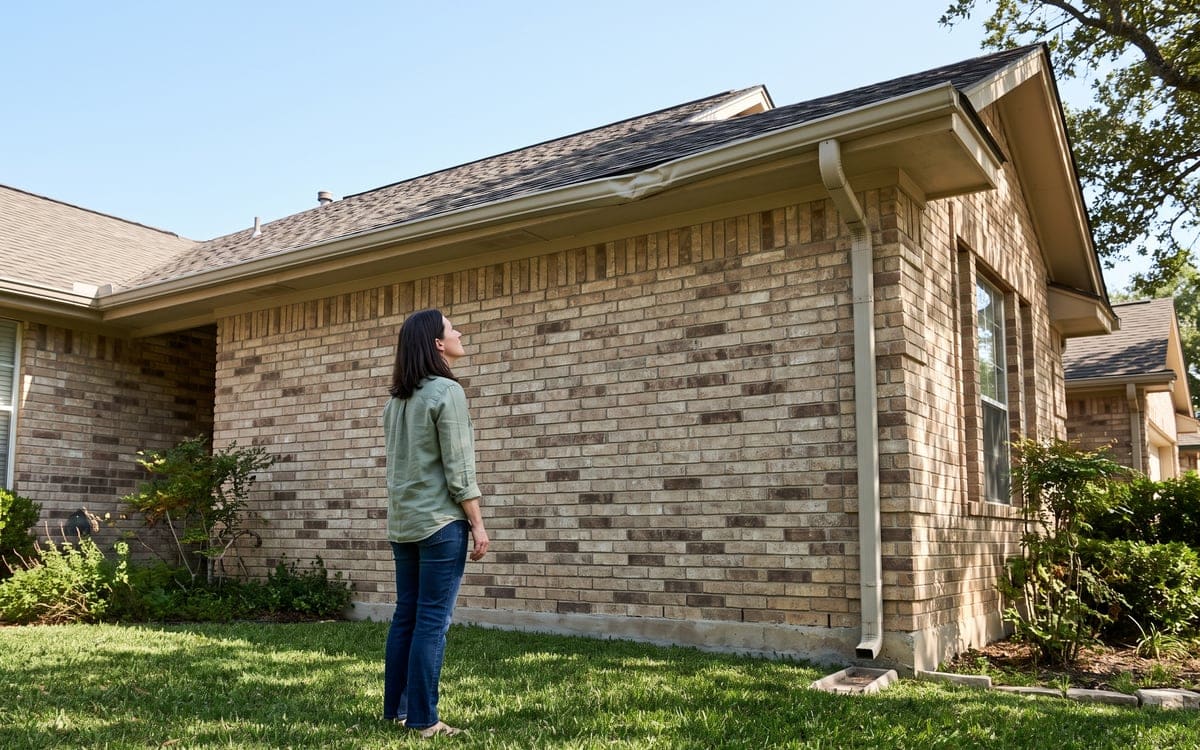
Not during or right after hail, and never near a downed or hanging line. Later, from the ground, these are the signs to look for:
- Dents on the gutters
- Dents on the vent caps along the roofline
- Shingle granules in a downspout's splash block or at the edges of a flower bed
- Any shingles or pieces of shingle on the lawn
A phone's zoom from the yard reads the ridge and slopes. For an active drip inside, move belongings and rugs and set a bucket under the drip; keep clear of a ceiling that sags or holds water and of wet light fixtures.
What a roofer checks after a hailstorm
A roofer's look is the whole roof, inside and out: the shingle field, the valleys, the course seals, the flashing at the chimney, walls and skylights, the vents and boots, the ridge and the gutters. The attic from the hatch is part of the look.
Across the slopes, the roofer reads the shingle field for dents, tears and granule loss. On a metal roof, the check reads panel dents, screw washers and the ribs. On a tile roof, each face is read.
Owens Corning writes that lost granules mean more UV exposure and more warping and cracking.7 For a smaller fix, roof repair in Austin covers patch and reseat work; for a whole-roof call, roof replacement in Austin covers the scope and metal roofing in Austin covers one of the hail-tested options.
Impact ratings, read as labels
Impact ratings on shingles are product labels from laboratory tests. ARMA says UL 2218 drops steel balls of various diameters from 12 to 20 feet onto a deck of shingles, and rates the product into one of four Classes, with Class 4 the highest;13 Classes I to IV represent tested resistances to impact energies of 3.53, 7.35, 13.56 and 23.71 foot-pounds,14 per NRCA. FM 4473 uses ice balls instead of steel. IBHS writes that impact-resistant shingles have passed one or the other test, with projectiles from 1 1/4 inches for Class 1 to 2 inches for Class 4.15
IBHS runs a newer test. Since 2019 it has used laboratory-made hailstones, which it says gives a more realistic measure of damage than traditional steel balls,6 judging the shingles on dents, tears and granule loss. In its 2025 ratings IBHS tested a record 24 impact-resistant shingle products, about 95 percent of that market, and while most earned Good, none earned Excellent.6 The scale runs Excellent, Good, Marginal, Poor, and IBHS says it does not recommend a product rated Marginal or Poor in areas that get hail.6
The labels have limits. ARMA says the product test standards apply to shingles "as manufactured" and do not fully replicate real-world conditions.13 IBHS researchers in NRCA's magazine put it another way: neither the UL 2218 nor the FM 4473 test accurately reproduces the kind and severity of damage found on roofs after hailstorms,15 and not all shingles labeled impact resistant perform equally.15 The labels help compare products; the real hail that reached a particular roof decides what has to be done after a storm.
| Where hail shows | What it looks like | What it can mean |
|---|---|---|
| Shingle field | IBHS's three damage modes: dents, tears, granule loss | ARMA: damaged shingles cause leaks |
| Shingle courses | Granule washout at valleys, in downspouts | Owens Corning: lost granules mean more UV exposure |
| Ridge cap | Cracks and broken caps | A roofer's look decides |
| Metal panel | Round dents on the panel | A close look at ribs, screw washers and fasteners |
| Clay or concrete tile | Readable face by face | TRI Alliance: replacement tiles must interlock to seat |
| Vent caps and jacks | Round dents | A roofer's look decides |
| Gutters and downspouts | Dents named in the 2009 NOAA report | Hail reached the house; the roof needs a roofer's look |